
Rethinking the Goldilocks Zone
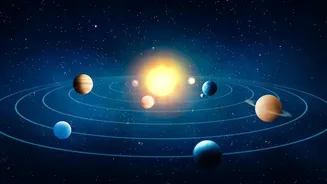
The idea of a habitable zone, often called the Goldilocks Zone, is simple and appealing. It describes the region around a star where a planet could potentially maintain liquid water on its surface—a key ingredient for life as we know it. If a planet is too
close to its star, its water boils away, like on Venus. If it's too far, its water freezes, like on Mars. For a long time, this has been the primary filter for identifying potentially life-bearing exoplanets. However, as our understanding of planetary science deepens, it's become clear that this is just the first, and perhaps simplest, step in a long checklist. A planet can be perfectly placed within this zone and still be a barren, hostile world. True habitability depends on a complex interplay of many other factors.
The Protective Embrace of an Atmosphere
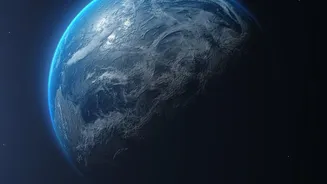
A planet's atmosphere is its first line of defence and its climate regulator. It’s not enough for a planet to just have an atmosphere; its thickness and composition are critical. An atmosphere that is too thin cannot provide enough pressure to keep water in a liquid state, nor can it offer adequate protection from harmful cosmic rays and stellar radiation. One that is too thick, like on a 'super-Earth' or 'mini-Neptune', could create a crushing greenhouse effect, making the surface too hot for life, and block the light needed for processes like photosynthesis. The ideal atmosphere contains a balanced mix of greenhouse gases to trap just enough heat, maintaining stable, life-friendly temperatures across the planet.
The Temperament of the Parent Star
Not all stars are created equal, and the nature of a planet's host star is a major factor in its habitability. Stars like our Sun are relatively stable, but many others, particularly smaller, cooler red dwarfs, are known for their violent temperaments. These stars can unleash powerful stellar flares and coronal mass ejections, blasting any nearby planets with intense radiation. This 'space weather' can strip a planet of its atmosphere over time, especially for worlds orbiting within the closer habitable zones of these smaller stars. The star's age also matters. As stars age, their luminosity changes, causing the habitable zone to shift. A planet that was once in a perfect spot might find itself scorched or frozen millions of years later.
An Inner Fire and a Magnetic Shield
What happens deep inside a planet is just as important as what happens on its surface. A geologically active world with a molten core is far more likely to be habitable. This internal heat can drive processes like plate tectonics, which helps recycle essential minerals and regulate climate over geological timescales. Moreover, a rotating, molten iron core generates a global magnetic field—an invisible shield that protects the planet. This magnetosphere deflects the stellar wind, a constant stream of charged particles from the host star that would otherwise erode the atmosphere. Mars, for example, is thought to have lost most of its once-thicker atmosphere and surface water after its internal dynamo shut down and its magnetic field vanished.
The Right Ingredients and a Stable Orbit
Beyond liquid water, life requires a variety of chemical building blocks, such as carbon, nitrogen, and phosphorus. A planet's composition must include these essential elements. The planet’s orbit and rotation also play a vital role. A world with a highly elliptical orbit might experience extreme temperature swings between its closest and farthest approaches to its star. Similarly, a planet that is 'tidally locked'—with one side perpetually facing its star—would have one hemisphere baked in eternal daylight and the other frozen in endless night, creating immense challenges for life to thrive across its surface. Finally, the presence of other planets in the system, like a large gas giant similar to Jupiter, can help stabilize the orbit of a smaller, terrestrial world and shield it from potentially devastating asteroid impacts.