
Reading an Alien Sky
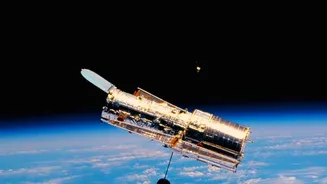
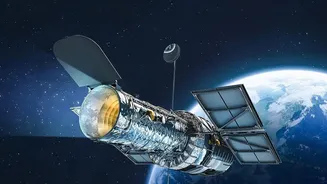
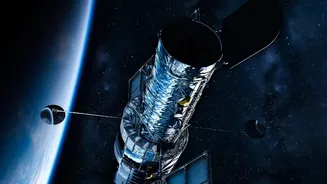
Imagine trying to understand the air quality of a city hundreds of light-years away. This is the challenge facing exoplanet scientists, and their primary tool is the James Webb Space Telescope (JWST). They use a technique called transmission spectroscopy.
When an exoplanet passes in front of its star from our point of view, a tiny amount of starlight filters through the planet's atmosphere. Different gas molecules absorb specific colours, or wavelengths, of light. By analysing the starlight that reaches the telescope, scientists can see which colours are missing and identify the chemical fingerprints of gases like carbon dioxide and methane. This process has allowed for the first-ever definitive detection of carbon dioxide in an exoplanet's atmosphere, a milestone achieved with the planet WASP-39b.
The All-Important Chemical Recipe
Finding these gases is exciting, but the real story lies in their relative amounts. Scientists are particularly interested in the carbon-to-oxygen (C/O) ratio. This ratio acts as a crucial clue to a planet's past. Carbon and oxygen are abundant elements in the universe, and they combine to form molecules like water (H2O), carbon monoxide (CO), carbon dioxide (CO2), and methane (CH4). The balance of these molecules in a planet's atmosphere reveals a great deal about the environment in which the planet was born. A planet's atmosphere is a chemical memory of its origins, holding secrets about where and how it came into being.
Two Ways to Build a Planet
Currently, there are two main theories for how giant planets form. The first is 'core accretion', a slow and steady process. Here, dust particles in the disk of gas and dust around a young star stick together, gradually building a solid core. Once this core becomes massive enough (around 10 times Earth's mass), its gravity rapidly pulls in a huge envelope of gas to form a giant planet. The second theory is 'gravitational instability'. This is a much faster and more dramatic process where a massive part of the disk itself becomes unstable and collapses directly to form a planet in a few thousand years. Determining which of these processes is more common is a major goal of modern astronomy.
Connecting Atmosphere to Origin
This is where carbon dioxide and methane come in. A young solar system has distinct zones. Closer to the star, it's hot, and molecules exist as gas. Further out, beyond what are called "ice lines," it's cold enough for substances like water, carbon dioxide, and carbon monoxide to freeze into solid ice. A planet that forms via core accretion far out in this icy region will incorporate a lot of frozen, oxygen-rich ices like water. Conversely, a planet forming closer in, or one that forms via gravitational instability from the gas of the disk, will have a different chemical makeup, often richer in carbon-based molecules like methane. By measuring the C/O ratio in a planet's atmosphere today, scientists can effectively reverse-engineer its birthplace and test which formation model fits the evidence.
Case Study: The Story of WASP-39b
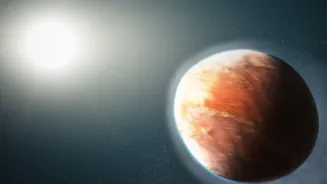
The hot, Saturn-mass planet WASP-39b provides a perfect example of this science in action. Located about 700 light-years away, its atmosphere has been studied in detail by JWST. Scientists found clear evidence of carbon dioxide and water, among other molecules. The specific chemical inventory, especially a higher amount of oxygen compared to carbon, strongly suggests that WASP-39b formed much farther away from its star than its current, scorching-hot orbit would imply. The theory is that it was born in the cold outer reaches of its solar system, where it was bombarded by icy bodies, and then migrated inward over time. This supports the core accretion model for this particular world, demonstrating how atmospheric data can reconstruct a planet's life story.