








A New Benchmark for Climate Science
Imagine trying to measure sea level rise with a ruler whose markings fade over time. That's the challenge facing climate scientists who rely on satellites. Instruments orbiting Earth are bombarded with radiation and operate in extreme temperatures, causing
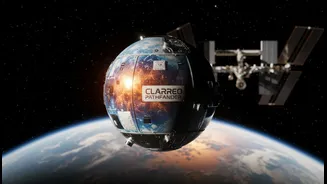
their sensors to degrade. This makes it incredibly difficult to distinguish a real climate trend from simple instrument drift. NASA's Climate Absolute Radiance and Refractivity Observatory (CLARREO) Pathfinder is designed to solve this very problem. Hosted on the International Space Station (ISS), this mission isn't about discovering a new planet; it's about perfecting how we see our own. Its primary goal is to take measurements of sunlight reflected from Earth with an unprecedented level of accuracy—five to ten times better than existing sensors. By doing so, it creates a highly reliable, SI-traceable benchmark that other satellites can be compared against.
The Art of Inter-Calibration
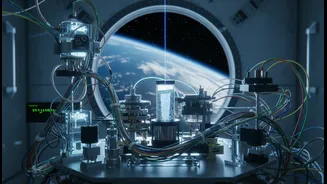
The key concept behind the Pathfinder's importance is 'inter-calibration'. Think of it as tuning an entire orchestra of instruments against a single, perfectly pitched tuning fork. The CLARREO Pathfinder is that tuning fork in space. The mission's hardware, specifically the Hyperspectral Imager for Climate Science (HySICS), can view the same location on Earth at the same time and angle as other satellites, such as the CERES and VIIRS instruments. By comparing its own highly accurate readings of reflected solar energy with those from another satellite, scientists can precisely measure and correct any inaccuracies in the other satellite's data. This process essentially transfers the Pathfinder's high accuracy to other missions, elevating the quality of the entire global network of Earth observations. This is a revolutionary step, moving from isolated data points to a cohesive, cross-validated system.
How It Achieves Unmatched Accuracy
The secret to the Pathfinder's precision lies in its ability to self-calibrate in orbit. While most satellites are calibrated on the ground and can only track their performance changes over time, CLARREO Pathfinder can reset its own accuracy throughout its mission. It does this by pointing its sensors at a known and stable source: the Sun. By regularly measuring the sun, a well-monitored calibration target, the instrument can account for any changes in its own sensitivity, ensuring its measurements remain anchored to unchanging international standards. It also uses the Moon as a stable calibration target, which in turn helps improve the Moon's usefulness as a reference for past, present, and future missions. This on-orbit-calibration capability is what makes it resilient to degradation and allows it to serve as a reliable reference for years.
A Legacy of Trustworthy Data
Although the CLARREO Pathfinder was designed as a one-year demonstration mission, its impact will be felt for decades. The data and methods it pioneers will inform the design of all future Earth-observation missions. Having a proven method for on-orbit inter-calibration means that future satellites can be built with this capability in mind, leading to a new generation of instruments that are more accurate from the outset. The mission's success demonstrates a cost-effective way to improve the value of multi-billion dollar satellite constellations already in orbit. More importantly, it helps scientists detect subtle climate trends, like changes in Earth's energy balance, much sooner and with greater certainty than ever before. This ability to get clear, reliable data faster is crucial for making informed policy and business decisions in response to a changing climate. The Pathfinder's legacy is not just better data, but greater confidence in the science that shapes our future.