
The Sheer Scale of a Gas Giant
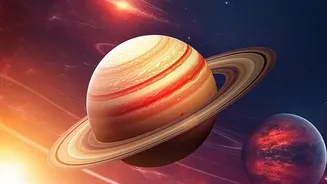
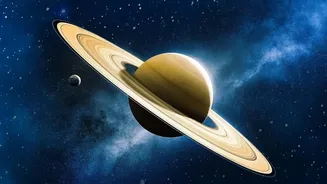
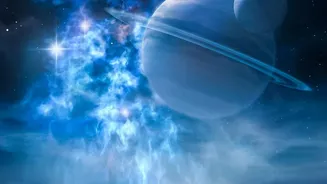
The most straightforward reason for Saturn's lunar bounty is its immense size and mass. Saturn is a gas giant, more than 95 times as massive as our rocky Earth. This colossal mass generates a powerful gravitational field that acts like a vast cosmic net.
While Earth's gravity is strong enough to hold onto one large moon and the occasional temporary satellite, Saturn's pull is in a different league entirely. Throughout the solar system's chaotic history, countless asteroids, comets, and icy bodies have drifted near the ringed planet. Its gravity was simply too powerful for many of them to escape, pulling them into orbit where they remain today as part of its enormous collection of moons.
Location, Location, Location
In space, as in real estate, location matters. Saturn orbits much farther from the Sun than Earth does. This distance is crucial because it gives Saturn a vast region of gravitational dominance, known as its Hill sphere. This is the zone around a planet where its own gravity overpowers the Sun's. Because Saturn is both massive and far from the Sun's primary pull, its Hill sphere is enormous, much larger than Jupiter's, despite Jupiter being more massive. This gives Saturn a larger effective area to capture and hold onto passing objects. Earth, being much closer to the Sun, has a smaller Hill sphere and faces more competition from the Sun's gravity, making it much harder to acquire and retain a large family of moons.
Two Very Different Birth Stories
Beyond simply capturing moons, Saturn also created them. Scientists believe that as Saturn formed, it was surrounded by a massive disk of gas, dust, and ice—much like a miniature version of the disk that formed the planets around the Sun. Many of Saturn's inner moons are thought to have coalesced from this material, forming alongside the planet itself. This co-formation process is common for gas giants. Earth's Moon, however, has a much more violent and unique origin story. The leading theory, known as the Giant-Impact Hypothesis, suggests that a Mars-sized object named Theia slammed into a young Earth billions of years ago. The cataclysmic collision flung a massive cloud of debris into orbit, which eventually clumped together to form the single, large Moon we see today.
A Legacy of Collisions and Debris
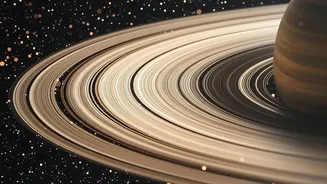
Many of Saturn's moons, especially the smaller, outer ones, have strange, irregular orbits. Some even travel backward relative to Saturn's rotation. Astronomers believe these are not original moons but are the remnants of larger bodies that were captured and then shattered by collisions millions or billions of years ago. These ancient smash-ups created families of smaller fragments that now orbit the planet as distinct groups. Saturn's famous rings also play a part. While the main rings lie within a zone where large moons would be torn apart by gravity, some scientists theorize that material at the rings' outer edges can clump together to form new, tiny moonlets. This makes the Saturnian system a dynamic and ever-changing environment where the moon count isn't just high; it's still being written. With improving telescope technology, astronomers are constantly finding new, tiny additions, with the confirmed count rising to 293 as of June 2026.