







A New Polygon on the Ringed Planet
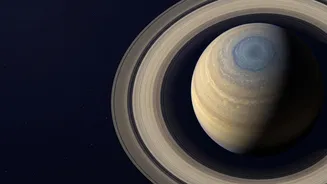
Scientists have announced a stunning discovery in our own solar system: a colossal ten-sided atmospheric pattern, or decagon, churning around Saturn's south pole. The finding, published in early September 2026, provides a surprising southern counterpart
to the planet's famous northern hexagon. For years, the hexagon was considered a complete anomaly, a one-of-a-kind feature with no parallel. This new discovery challenges that assumption, suggesting that the conditions on the gas giant are uniquely suited to creating giant, stable geometric storms. Researchers are now watching what they believe is a new atmospheric phenomenon taking shape, offering a rare, real-time glimpse into the physics of distant worlds.
A Truly Astronomical Scale
The sheer size of this new decagon is difficult to comprehend. Each of its ten sides measures approximately 10,425 miles (about 16,782 kilometers) in length. To put that into perspective, a single side of this storm is longer than the entire diameter of Earth, which is about 7,900 miles. You could fly from Mumbai to Sydney and still not cover the length of one of the decagon's straight edges. The entire structure spans a staggering 104,250 miles across, making it significantly larger than the already enormous northern hexagon, which is about 20,000 miles wide. Unlike fleeting terrestrial storms, this decagon is a vast, organized structure carved into the planet’s atmosphere by powerful winds.
How Astronomers Found It
The discovery was a case of cosmic patience and sharp-eyed observation. Saturn's axial tilt meant that its southern pole was largely hidden from Earth's view between 2012 and 2023. As the planet's seasons changed and the pole tilted back towards us, astronomers using NASA's Hubble Space Telescope got their first clear look. In images from 2023 onwards, scientists began to see hints of the structure emerging. The find was bolstered by a network of amateur astronomers who also spotted the strange pattern. It turns out that while NASA's Cassini spacecraft, which orbited Saturn for 13 years, never saw a stable southern polygon, the feature began forming more recently, giving scientists a front-row seat to its evolution.
The Making of a Cosmic Storm
So, how does a planet's atmosphere form a near-perfect, ten-sided shape? While the exact mechanism is still under investigation, the leading theory is that the decagon, like its hexagonal sibling, is a massive jet stream. This river of gas, moving at hundreds of miles per hour, is believed to form a 'standing wave' that gets locked into a stable polygonal shape. Scientists have been able to replicate similar phenomena in laboratory settings using rotating tanks of liquid. By spinning the fluid at different speeds, they can create turbulence that settles into stable shapes with three to eight sides, suggesting that the physics behind these cosmic patterns, while rare, are a natural outcome of certain atmospheric conditions.
Why This Discovery Is a Game Changer
The existence of the southern decagon is more than just a curiosity; it fundamentally changes our understanding of Saturn. It proves that the northern hexagon is not a freak occurrence but part of a planetary system capable of producing multiple, long-lasting geometric storms. This provides planetary scientists with an invaluable second laboratory to study how such features form and evolve. While the northern hexagon has been stable for at least 45 years, the southern decagon appears to be a newer, still-developing feature. Observing whether it stabilizes, changes shape, or dissipates will provide crucial data on the complex and powerful forces at play deep within the atmospheres of gas giants.