





What 'Opposition' Actually Means
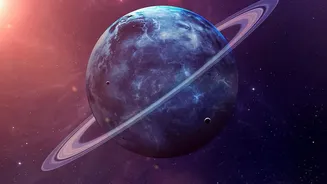
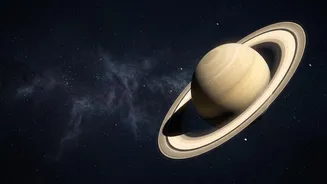
In simple terms, opposition is a special alignment that happens once a year for Saturn. On October 4, 2026, Earth will pass directly between the Sun and Saturn. This places the ringed planet on the opposite side of the sky from the Sun, from our perspective.
Because of this alignment, Saturn will be at its closest point to Earth for the year, a distance of about 1.26 billion kilometres. This proximity makes it appear larger and more brilliant, offering an ideal window for observation that lasts for several weeks around the main event. For a few days, the rings may even appear unusually bright due to a phenomenon called the Seeliger effect, where the icy particles of the rings reflect sunlight directly back at us without casting shadows.
When and Where to Look
The key date is October 4, but the viewing is excellent throughout the month. Saturn will be visible all night long, rising in the eastern sky around sunset, reaching its highest point around midnight, and setting in the west as the sun rises. For viewers in India, Saturn will rise at approximately 6:11 pm IST on October 4, be at its highest point around 12:17 am, and set at about 6:23 am the next morning, providing a generous nearly 12-hour window. You can find Saturn shining brightly in the faint constellation of Cetus, the Whale. It will appear as a steady, yellowish-white point of light, unlike stars which tend to twinkle. If you need help, a stargazing app on your smartphone can point you in the right direction.
Naked Eye, Binoculars, or Telescope?
You don't need any special equipment to see Saturn itself. It will be readily visible to the naked eye as one of the brightest objects in its part of the sky, shining at a magnitude of around 0.3. However, to see its most famous feature—the rings—you will need some optical aid. High-powered binoculars might show the planet as a tiny, non-circular oval, but a telescope is required to truly resolve the rings. Even a small beginner's telescope with at least 25x to 50x magnification should be able to show the rings as a distinct structure separate from the planet. A larger amateur telescope, perhaps 150mm (6-inch) or more, will provide a much more satisfying view, potentially revealing the dark gap known as the Cassini Division between the main rings on a clear night.
Tips for the Best View
To get the sharpest view, try to observe Saturn when it is highest in the sky, around midnight. This reduces the amount of Earth's turbulent atmosphere you have to look through. While you can see the planet from a city, finding a location away from bright city lights will always improve the experience. Give your eyes a few minutes to adjust to the darkness. If you are using a telescope, let it sit outside for a while to adjust to the ambient temperature, which helps prevent blurry images. Patience is key; wait for moments of steady air, and you will be rewarded with a clearer, more detailed image of this distant world. The good news for observers is that the Moon will be in a waning phase in early October, meaning its light won't interfere with your view during the peak opposition week.
A Comeback for the Rings
This year's opposition is particularly special. In March 2025, Earth passed through the plane of Saturn's rings, making them appear nearly invisible from our vantage point. Now, the rings are beginning to open up again, with their southern face tilted about 7.5 degrees toward us. While still a relatively narrow angle, it is more than enough to provide a stunning view. Seeing the rings, made of countless pieces of ice and rock, is a bucket-list item for many skywatchers. This celestial event provides a perfect opportunity to connect with the grandeur of our solar system, witnessing a sight that has inspired awe for centuries, right from your own backyard or a nearby open space.