




Seeing the Invisible Universe
When we look at a classic space image, we're usually seeing what the human eye could see, if it were powerful enough. But that visible light is just a tiny slice of the total information an object emits. The universe is buzzing with activity across the entire
electromagnetic spectrum, from low-energy radio waves to high-energy X-rays and gamma rays. Different celestial events and materials produce different types of light. Cool clouds of dust and gas glow in infrared, while superheated material spiraling into a black hole blasts out X-rays. To get a complete picture, astronomers need to observe the same object with different kinds of telescopes, each designed to capture a specific part of this spectrum. This technique, known as multi-wavelength astronomy, is like assembling a puzzle where each piece provides a crucial and unique clue.
A Case Study: The Barred Spiral Galaxy NGC 1672
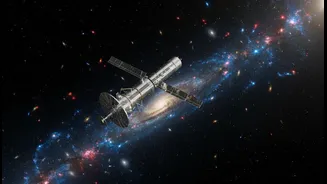
Let's take the barred spiral galaxy NGC 1672, located about 60 million light-years away, as a prime example. It’s a stunning galaxy with a prominent bar of stars across its center and sprawling spiral arms. By combining data from NASA's Chandra X-ray Observatory, the James Webb Space Telescope (JWST), and the Hubble Space Telescope, scientists can move beyond a single, static portrait and build a dynamic map of everything happening within it. Each telescope tells a different part of the story, layering their findings to reveal the galaxy's intricate machinery at work.
The X-Ray View: Unmasking Violence and Energy
NASA's Chandra X-ray Observatory is designed to detect high-energy X-rays, which are produced by the most violent and energetic processes in the universe. When pointed at NGC 1672, Chandra’s vision cuts through the glow of stars and dust. Its data reveals a cluster of incredibly hot, young, and massive stars, which give off copious amounts of X-rays. Even more dramatically, it uncovers the intense activity at the galaxy's very core. NGC 1672 is classified as a Seyfert galaxy, meaning it has an active galactic nucleus powered by a supermassive black hole feeding on surrounding gas and dust. Chandra sees the superheated material in the accretion disk around this black hole, an engine of activity that can sometimes outshine the entire host galaxy.
The Infrared View: Peering Through Dust to See Birth
While X-rays show destruction and high energy, infrared light, captured by telescopes like JWST and the retired Spitzer, reveals the opposite: creation. Dark lanes of dust that appear opaque in visible light become transparent when viewed in infrared. Peering through these dusty curtains, JWST sees the faint glow of cool gas and dust—the raw materials for new stars. In its images of NGC 1672, the dust lanes that look like dark voids in Hubble's view instead glow brightly, showing where the galaxy's building blocks are concentrated. This infrared vision is essential for mapping stellar nurseries and understanding how and where a galaxy is actively forming its next generation of stars.
The Optical View: The Familiar Glow of Stars
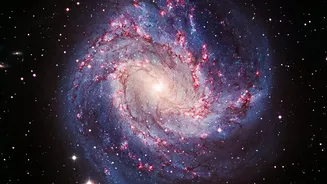
The Hubble Space Telescope provides the sharp, visible-light view that we are most familiar with. Its observations of NGC 1672 detail the distribution of billions of stars that give the galaxy its fundamental structure. Hubble images clearly define the bright bar crossing the galactic center and the spiral arms twisting outwards. We can see clusters of hot, young blue stars tracing the edges of the arms, along with reddish clouds of hydrogen gas that have been ionized, or lit up, by the radiation from these newborn stars. While it can't see the highest-energy phenomena or peer through the thickest dust, Hubble's optical view provides the essential framework and context for the other observations.
The Complete Picture
When astronomers digitally combine these separate views, assigning different colors to the X-ray, infrared, and optical data, a breathtakingly complete picture of NGC 1672 emerges. Suddenly, it's not just a pretty spiral. It’s a living ecosystem. We can see high-energy X-ray sources from the black hole and massive stars nestled within the glowing infrared dust clouds where they were born. We see the star-forming regions revealed by JWST located precisely along the spiral arms and bar structure mapped by Hubble. This composite approach allows scientists to trace the flow of matter and energy, connecting the central black hole's activity to the star formation happening millions of light-years away in the arms. This is how we begin to understand a galaxy not as an object, but as a place with complex, interconnected activity.