





The Challenge of a Messy World
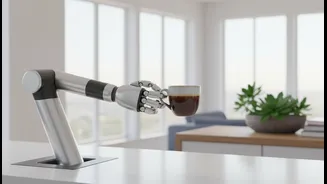
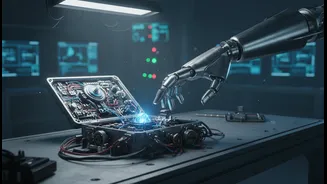
While AI models have become incredibly adept at processing language and data, the physical world presents a far more complex challenge. Unlike the predictable realm of digital information, the real world is unstructured, dynamic, and full of nuance. This
is often called Moravec's paradox: tasks that are hard for humans (like complex math) are easy for computers, while tasks that are easy for humans (like picking up a cup) are incredibly difficult for robots. Physical AI must grapple with constant, unpredictable changes in lighting, texture, and object position. A robot designed for a specific task in a controlled environment often fails when faced with the slightest variation, a problem that highlights the gap between rigid programming and adaptive, real-world capability.
The Gap Between Simulation and Reality
To accelerate training, robotics teams heavily rely on simulations. In these virtual worlds, a robot can practice a task millions of times without risking damage to expensive hardware. The problem is the “sim-to-real” gap. A policy that achieves a 95% success rate in a clean simulation may drop to 20% on real hardware. This happens because simulations are only approximations of real-world physics. They struggle to perfectly replicate complex factors like friction, material deformation, sensor noise, and contact dynamics. This discrepancy means that a model trained exclusively in a virtual environment often lacks the robustness to handle the subtle, unmodeled phenomena of the physical world.
The Common Sense Deficit
One of the most significant hurdles for physical AI is the lack of what we call common sense. Humans possess a vast, intuitive understanding of how the world works. We know a paper cup can be crushed, a balloon will pop if poked, and water shouldn't be poured on electronics. AI, however, lacks this background knowledge. A robot may learn to water a plant perfectly, but without common sense, it might also try to water a person's shoes when asked to "water my friend." This isn't a failure of learning the specific task, but a failure to understand the broader context—a critical limitation when deploying robots in human-centric environments. Bridging this gap is a long-standing challenge in AI research.
The Hardware Bottleneck
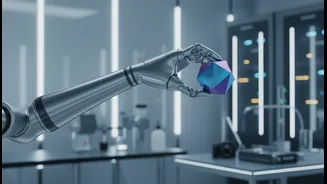
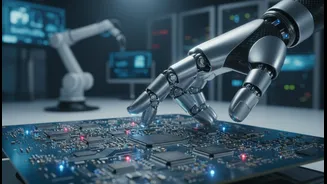
Software and algorithms are advancing rapidly, but physical AI is fundamentally constrained by its hardware. No matter how intelligent the AI model, its actions are limited by the robot's physical body. Key hardware challenges remain significant bottlenecks. Battery technology, for instance, has not kept pace with the power demands of AI computation, limiting a robot's operational time and mobility. Furthermore, actuators and motors still struggle to replicate the fluid, dexterous movements of a human hand, making complex manipulation tasks like turning a doorknob or using a tool extremely difficult. These physical constraints—from power and processing to the mechanics of movement—are where the theoretical promise of AI meets hard reality.