



Why Venus? Earth's Runaway Twin
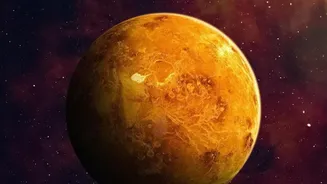
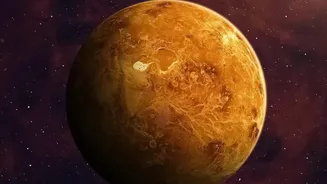
For decades, Mars has captured our imagination as the next frontier, but scientists are increasingly turning their attention back to Venus. Though similar to Earth in size, mass, and composition, Venus is a planetary cautionary tale. It suffers from a runaway
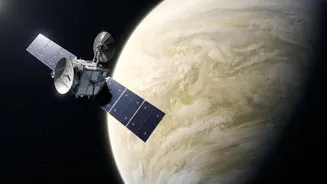
greenhouse effect, trapping heat so effectively that its surface temperature is hot enough to melt lead, around 475 degrees Celsius. Its atmosphere is a crushing force, with surface pressures over 90 times that of Earth's. By studying how and why Earth's twin took such a dramatically different evolutionary path, scientists hope to gain invaluable insights into planetary climate change, atmospheric loss, and even the long-term future of our own world. The Shukrayaan orbiter, formally approved by the Indian government in September 2024, represents India's ambitious step into this vital area of planetary science.
The Mission's Primary Goals
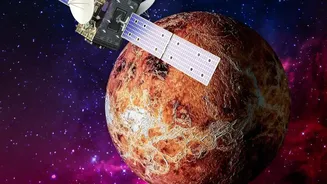
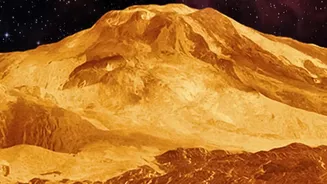
Shukrayaan-1 is not just a symbolic journey; it's a dedicated scientific expedition with clear objectives. The mission is designed to conduct a comprehensive investigation of Venus from orbit for over four years. A key goal is to map the planet's surface and sub-surface, which remains poorly understood due to the impenetrable cloud cover. Scientists are eager to hunt for signs of active volcanoes, chart ancient lava flows, and understand the planet's geology. Another major focus is the atmosphere itself. The orbiter will analyze the composition and dynamics of the thick carbon dioxide atmosphere, studying its super-rotating winds and the chemistry of its sulfuric acid clouds. Finally, Shukrayaan-1 will examine the interaction between Venus and the solar wind, helping scientists understand how the planet lost its magnetic field and most of its water.
A Toolkit for a Hostile World
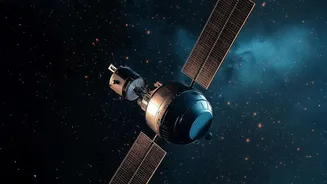
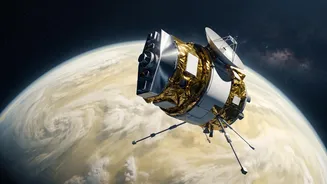
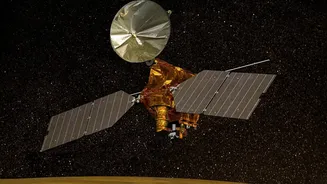
To achieve these goals, ISRO is equipping the approximately 2,500 kg spacecraft with a suite of sophisticated instruments weighing around 100 kg. The star of the show is a high-resolution Synthetic Aperture Radar (SAR), which can peer through the dense clouds to map the surface in remarkable detail, day or night. This instrument is expected to have a resolution four times greater than NASA's Magellan mission in the 1990s. Another pioneering instrument is a ground-penetrating radar, a first for Venus exploration, designed to study the planet's sub-surface geology. The payload also includes instruments developed with international partners, such as Sweden, Germany, and a collaboration between Russia and France, to analyze atmospheric gases and the planet's interaction with plasma from the Sun.
The Challenge of Reaching Venus
A mission to Venus is fraught with technical hurdles. The extreme heat, crushing pressure, and corrosive atmosphere make it one of the most challenging destinations in the solar system. While Shukrayaan is an orbiter and won't face the full wrath of the surface, its journey and operation are complex. Scheduled for launch aboard an LVM-3 rocket on March 29, 2028, the spacecraft will embark on a 112-day journey to reach its destination. Upon arrival on July 19, 2028, it will enter a large elliptical orbit. From there, it will perform a series of daring aerobraking manoeuvres, dipping into the upper atmosphere to use drag to gradually lower its orbit to the desired 200 x 600 km for scientific observation, a technique that saves a significant amount of fuel.
India’s Next Interplanetary Leap
Following the monumental successes of Chandrayaan and the Mangalyaan Mars Orbiter Mission, Shukrayaan-1 cements ISRO's position as a major player in interplanetary exploration. It demonstrates not only scientific ambition but also a growing capability to execute complex, long-duration missions on a cost-effective budget of approximately ₹1,236 crore. By joining a new wave of international missions heading to Venus, India will contribute a critical, independent dataset that will help scientists build the most complete picture of the planet ever assembled. This mission is more than just a visit to a neighbouring planet; it's a testament to India's scientific prowess and a crucial investment in understanding our own place in the solar system.