




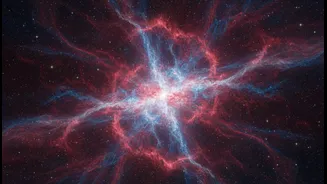



A World of a Different Color
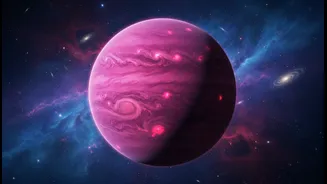
First discovered in 2013 using the Subaru Telescope in Hawaii, GJ 504 b immediately captured the imagination of astronomers and the public. Its distinct magenta hue isn't from a surface or an ocean, but from the glowing heat of its own formation. While
its size is similar to Jupiter, it's estimated to be several times more massive. Recent observations have placed its mass at potentially 25 times that of Jupiter. This massive object orbits a sun-like star, but at a distance nearly nine times greater than Jupiter's orbit around our sun, a placement that raises profound questions for astronomers. Its temperature is a relatively cool 290 degrees Celsius, which, while hot enough to bake bread, makes it one of the coldest such worlds ever directly imaged.
The Planet That Shouldn't Exist
The existence of GJ 504 b is a direct challenge to the leading theory of how giant planets form, known as core accretion. This model suggests that planets grow from a solid core built up by collisions of asteroids and comets in the dusty disk around a young star. Once the core is massive enough, its gravity rapidly pulls in gas to form a giant planet. This theory works well for planets closer to their star, like Jupiter. However, it struggles to explain how a planet as massive as GJ 504 b could have formed so far out in its solar system, where the raw materials for building a large core should be scarce. Its distance from its star is so great that, according to the core accretion model, it simply shouldn't have been able to gather enough mass.
Rewriting the Rules of Formation
So if not by core accretion, how did this pink giant come to be? Its puzzling existence lends weight to an alternative theory called gravitational instability. This model proposes that under certain conditions, a young star's protoplanetary disk can become so massive and unstable that parts of it collapse under their own gravity, directly forming a giant planet in a much shorter timeframe—hundreds of years versus millions. The characteristics of GJ 504 b make it a prime candidate for this formation method. Determining whether it is a true planet or a 'brown dwarf'—a kind of failed star—is a central question for scientists. Its large mass puts it right on the borderline between the two classifications, making it a crucial object for study.
A Salty, Metallic Atmosphere
Thanks to the powerful capabilities of the James Webb Space Telescope (JWST), our view of GJ 504 b has become even more intriguing. Recent observations have provided the first direct evidence of salt clouds in its atmosphere, a phenomenon theorized but never before directly observed on such a world. By analyzing the light from the planet, scientists detected a complex mix of molecules, including water vapor, methane, and carbon dioxide. However, the data only made sense when models included the presence of these unusual salty clouds. This discovery not only helps explain some of the planet's unique properties but also provides a new tool for understanding the atmospheres of other cold, distant worlds.