


Seeing the Invisible
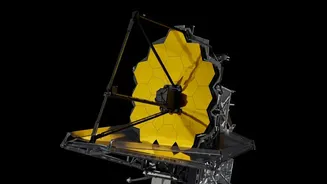
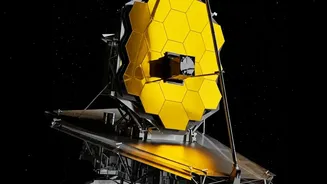
The magic behind the James Webb Space Telescope is its ability to see the universe in infrared light. This is light that is invisible to the human eye, but it holds the secrets to understanding planetary atmospheres. When an exoplanet passes in front
of its host star, the starlight filters through the planet's atmosphere. Different gases and chemicals absorb specific wavelengths, or colors, of this light. By capturing this filtered light with its powerful spectrographs, JWST can create a 'spectrum'—a sort of chemical fingerprint of the atmosphere. This technique, known as transit spectroscopy, allows scientists to identify the molecules present, from water vapor to carbon dioxide and even more exotic compounds.
A Portrait of Alien Skies
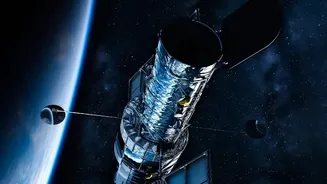
One of the telescope's first major successes was a detailed atmospheric profile of WASP-39 b, a gas giant orbiting a star 700 light-years away. Before JWST, we had hints of its atmospheric composition from telescopes like Hubble. But Webb’s precision delivered an unprecedented molecular inventory. The data revealed clear evidence of water, carbon monoxide, sodium, and potassium. Most surprisingly, it made the first-ever detection of sulfur dioxide in an exoplanet's atmosphere, a molecule believed to be created by chemical reactions driven by the intense starlight hitting the planet—a phenomenon known as photochemistry. This finding proved that JWST could do more than just list ingredients; it could reveal active chemical processes happening in real-time.
From Molecules to Meteorology
Detecting molecules is one thing, but understanding weather is another. Weather is about dynamics: clouds, wind, and temperature changes. JWST is giving us our first glimpse into these processes on other worlds. On the extremely hot planet WASP-94A b, for instance, scientists observed a fascinating weather cycle. The planet is so hot that it has clouds made of minerals—specifically, magnesium silicate, a component of rocks on Earth. JWST's data showed that these rock-based clouds form during the planet's morning only to be burned away by the intense heat of its afternoon. This observation marks one of the clearest pictures of a daily weather pattern ever recorded on an exoplanet.
Mapping an Alien Climate
To understand global weather, you need a map. JWST can create rudimentary climate maps of exoplanets by observing them through their entire orbit. This method allows scientists to measure the temperature difference between the planet's permanent dayside and its cooler nightside. On worlds like WASP-17 b, this has revealed clouds of quartz nanocrystals that form on the nightside and evaporate on the scorching dayside. The temperature differences drive powerful winds that transport heat and chemicals around the planet. On WASP-107b, a 'super-puff' planet with a huge, low-density atmosphere, observations suggest significant vertical mixing is occurring, a key process that drives weather patterns on Earth by dredging up material from deep within the atmosphere.
The Search for Habitable Worlds
Ultimately, the study of exoplanet weather is tied to the search for life. On K2-18 b, a potential 'Hycean' world with a hydrogen-rich atmosphere and a possible global ocean, JWST detected methane and carbon dioxide. While these can be produced by geological processes, they are also key biosignatures on Earth. The telescope even picked up a tentative signal for dimethyl sulfide (DMS), a compound on Earth produced almost exclusively by marine life. This detection is still heavily debated among scientists, but it highlights the astonishing capability of the telescope. By understanding the clouds, chemistry, and climate of these distant worlds, we are taking the first crucial steps toward identifying planets that could truly be habitable.