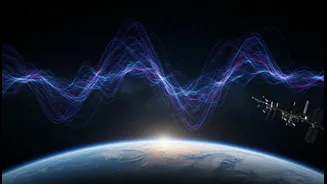








A Quantum Freezer in Orbit
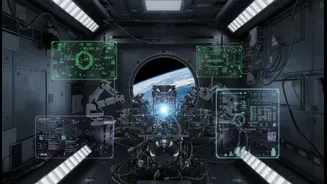
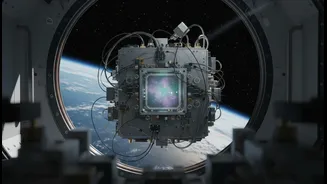
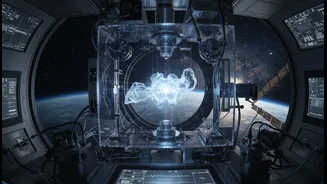
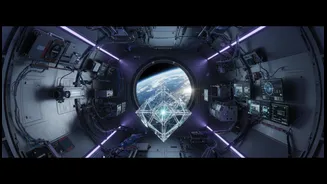
Since 2018, NASA's Cold Atom Lab (CAL) has been operating as a one-of-a-kind physics facility on the International Space Station (ISS). Its mission is to study the strange and wonderful world of quantum mechanics by cooling atoms to temperatures just
a sliver above absolute zero, the coldest possible temperature where all atomic motion should cease. Controlled remotely from Earth by scientists at NASA's Jet Propulsion Laboratory, CAL uses a sophisticated combination of lasers and magnetic fields to slow down clouds of atoms like rubidium and potassium, chilling them to less than a billionth of a degree above absolute zero. At these extreme temperatures, atoms start to behave in ways that defy our everyday experience, offering a unique window into the fundamental laws of nature.
Creating the Fifth State of Matter
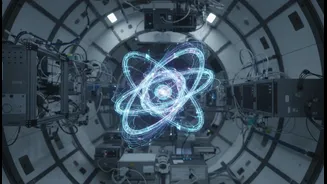
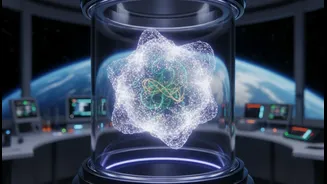
The primary goal of cooling these atoms is to create a Bose-Einstein Condensate (BEC), often called the fifth state of matter, distinct from solids, liquids, gases, and plasmas. First predicted by Satyendra Nath Bose and Albert Einstein in the 1920s and created in a lab in 1995, a BEC forms when atoms become so cold and slow that their individual quantum identities merge. Instead of acting like a collection of tiny, separate billiard balls, they begin to behave as a single, coherent quantum object, or 'super atom'. This macroscopic quantum state makes the bizarre effects of quantum mechanics, which are usually confined to the subatomic scale, large enough for scientists to observe and study directly.
Why Microgravity is a Game Changer
On Earth, gravity is a constant nuisance for scientists trying to study BECs. The moment a condensate is formed, gravity pulls it down, and it can typically only be observed for a fraction of a second before it falls out of the experimental apparatus. This is where the ISS provides a crucial advantage. In the microgravity environment of orbit, the pull of gravity is effectively neutralized. This allows the Cold Atom Lab to produce BECs that can be observed for much longer periods—upwards of 10 seconds or more. This extended observation time is critical, as it allows scientists to make more precise measurements and to witness subtle quantum phenomena that are simply impossible to see on the ground.
The Promise of Precision Sensing
These ultra-cold, well-behaved atoms are not just a scientific curiosity; they are the key to a new generation of incredibly precise sensors. Because the atoms in a BEC move in unison, they are extremely sensitive to the slightest external forces, including gravity, magnetic fields, and acceleration. By using techniques like atom interferometry, which measures how these atom waves interact, scientists can build instruments with unprecedented accuracy. Potential applications are transformative and include developing ultra-precise atomic clocks for timekeeping, creating navigation systems that don't rely on GPS, and building gravity sensors that can map underground water reserves, monitor ice sheets, or even detect hidden tunnels and volcanic activity from space.
Unlocking the Universe's Biggest Mysteries
The bigger story of the Cold Atom Lab extends beyond practical technologies and into the realm of fundamental physics. The ability to manipulate and observe quantum matter with such control in space opens the door to tackling some of the biggest unanswered questions in science. These highly sensitive quantum sensors could one day be used to search for dark energy, the mysterious force thought to be accelerating the expansion of the universe, or to detect faint gravitational waves from cosmic events. Experiments on CAL are also testing the foundations of quantum mechanics itself, probing how atoms can exist in multiple places at once and behave as both particles and waves. Upgrades to the facility continue to push the boundaries of what is possible, giving researchers ever more powerful tools to explore this strange quantum frontier.