



The Best of Both Worlds?
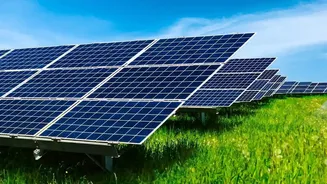
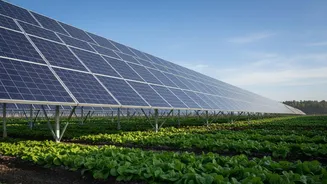
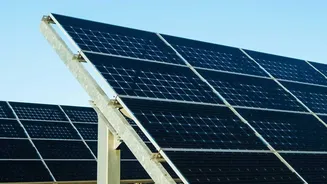
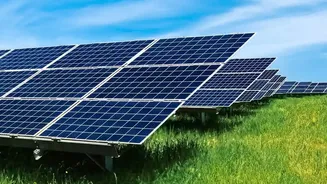
At its core, agrivoltaics is the practice of using land for both agriculture and solar power generation. Solar panels are installed on elevated structures, high enough for crops to be grown underneath or for livestock to graze. The concept, first proposed
in the 1980s, addresses a major challenge for a country like India: competing demands for land. With a growing population, fertile land is needed for food, while ambitious renewable energy targets require vast areas for solar farms. Agrivoltaics offers a way to avoid this trade-off by making a single plot of land do double duty. This integration is seen as a key strategy to boost land productivity, potentially increasing a farm's total output significantly compared to using separate plots for farming and energy generation.
India’s Land and Energy Puzzle
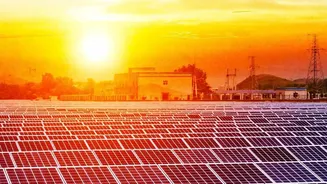
India has set ambitious goals to generate 500 GW of its power from non-fossil fuel sources by 2030, with solar power being a massive component. However, conventional ground-mounted solar farms can consume large tracts of land, sometimes leading to conflicts over agricultural or ecologically sensitive areas. Agrivoltaics is emerging as a powerful solution. Government initiatives like the PM-KUSUM scheme are already encouraging farmers to install solar power plants and pumps, aiming to decarbonise the agricultural sector and provide an additional income stream for farmers. By turning farms into dual-purpose powerhouses, agrivoltaics aligns perfectly with national priorities of ensuring energy security without compromising food production.
The Big Win: Saving Water on the Farm
Here's where the water story begins, and it's largely positive. In many parts of India, agriculture is water-intensive and often takes place in arid or semi-arid regions facing water stress. The solar panels in an agrivoltaic system create a unique microclimate. By providing shade, they reduce direct sun exposure on the crops and soil. This lowers the ambient temperature and, crucially, reduces the rate of evapotranspiration—the process by which water is lost from the soil and plants. Studies have shown this can reduce the need for irrigation by 30% or more, a significant saving in water-scarce areas. For farmers in drought-prone zones, this means more resilient crops and lower water bills.
The Hidden Water Cost: Cleaning the Panels
However, the water equation isn't entirely one-sided. To operate efficiently, solar panels must be kept clean from dust, dirt, and bird droppings, which can significantly reduce their power output. In India's often dusty conditions, this can mean weekly cleaning. Traditional wet cleaning methods can be water-intensive, using anywhere from 3 to 8 litres of water per panel per wash. For a 1 MW solar park, this can translate to thousands of litres of water for each cleaning cycle. This raises a critical question: does the water used for cleaning offset the water saved in irrigation? In many water-stressed regions where large solar capacity is being installed, this is a serious concern.
Finding the Right Balance
The good news is that this challenge is being met with innovation. The industry is rapidly developing more water-efficient cleaning methods. These include robotic dry-cleaning systems that use brushes instead of water, and specialised cleaning solutions that require only a fraction of the water used in traditional methods—sometimes as little as 200-300 ml per panel. Furthermore, some pilot projects are integrating rainwater harvesting structures to collect runoff from the panels, creating a self-sufficient system for both cleaning and supplemental irrigation. While coordinating cleaning schedules with crop irrigation can be a logistical challenge, the overall consensus is that with smart management and the adoption of new technologies, the water-saving benefits of agrivoltaics far outweigh the costs of panel maintenance.