


A Glimpse Into Cosmic Nurseries
Imagine looking back in time 4.6 billion years to witness the birth of our own Solar System. That’s essentially what the James Webb Space Telescope is allowing astronomers to do. Recent observations are focused on protoplanetary disks—vast, spinning platters
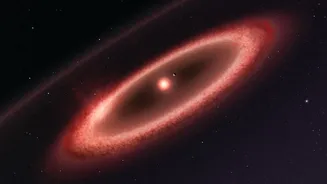
of gas and dust that surround young, infant stars. These disks are the raw materials from which planets, asteroids, and comets are made. For decades, scientists have theorised about how these cosmic ingredients clump together to form worlds, but seeing the process with such clarity was impossible until now. JWST’s powerful infrared instruments can pierce through the dense clouds of dust that obscure these stellar nurseries from other telescopes, revealing the intricate dance of matter that leads to new worlds.
What the New Images Reveal
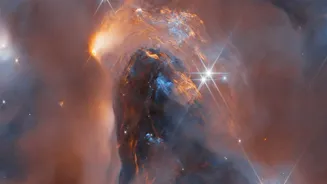
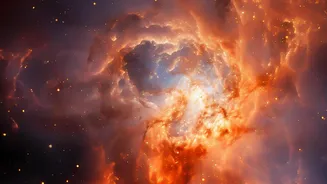
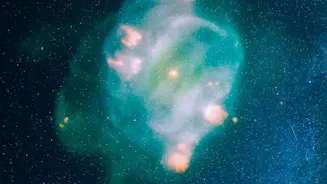
The latest dispatches from JWST showcase several star systems in the process of formation, some located roughly 450 to 480 light-years away in the constellations of Taurus and Ophiuchus. The images reveal structures that look like glowing, colourful spinning tops or hourglasses. This unique shape is due to our edge-on view of the protoplanetary disks, which conveniently blocks the blinding light of the central star. This allows scientists to study the fainter glow of dust and gas being sculpted by the infant star's activity. One major study, led by Naman Bajaj at the University of Arizona, examined 72 young, sun-like stars to understand how planets form in a race against time. The findings show that powerful jets and winds, driven by the star's magnetic fields, actively blow away the gas needed to form giant planets like Jupiter.
A Race Against Time
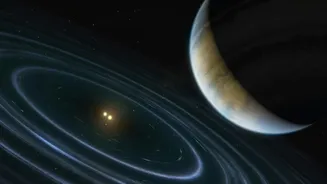
The formation of planets, particularly gas giants, is a time-sensitive event. These massive worlds need to gather their enormous atmospheres from the surrounding disk before it dissipates. The new JWST research shows that the mechanisms clearing out this gas change as the star system ages. In the early stages, strong magnetic winds dominate, but later, a process called photoevaporation takes over, where the star's own high-energy radiation heats up the gas until it escapes. According to Uma Gorti from the SETI Institute, this dispersal sets a fundamental clock for planet formation; once the gas is gone, the chance to build gas-rich planets is over. This helps explain why planetary systems like our own have a mix of smaller rocky worlds and gas giants—it all depends on how much material was available and for how long.
The Technology Driving Discovery
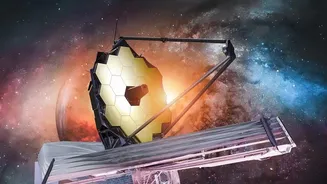
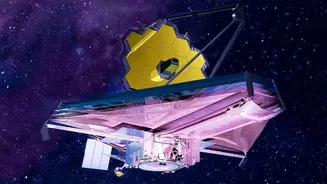
These groundbreaking observations are possible thanks to JWST’s specialised instruments, primarily the Mid-Infrared Instrument (MIRI) and the Near-Infrared Camera (NIRCam). These tools allow the telescope to see in infrared light, which can penetrate the thick dust that shrouds newborn stars. The different colours in the images are not just for aesthetic appeal; they represent the chemical composition of the disk, indicating the presence of molecules like hydrogen and carbon monoxide, as well as complex organic compounds. By tracking these elements, scientists can map the chemistry of planet formation and understand how the building blocks of life might be distributed throughout a young solar system. These insights are a massive return on the technological investment in the $10 billion observatory.
Rewriting the Story of Our Origins
Every new image from JWST helps refine and sometimes challenge our existing models of planet formation. By studying dozens of young systems at different stages, astronomers can essentially create a 'movie' of how a planetary system evolves from a chaotic cloud of gas and dust into an orderly collection of planets. These observations are more than just pretty pictures; they are a window into our own cosmic past. They help us piece together the story of how Earth and its neighbours formed around our infant Sun. As the telescope continues its mission, it will undoubtedly uncover more secrets hidden within these stellar nurseries, further transforming our understanding of our place in the universe.