

Catching a Planet's Shadow
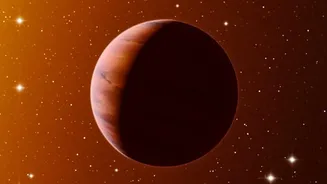
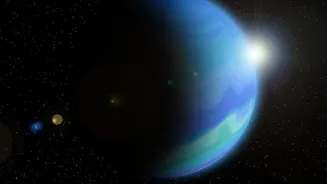
The entire process begins with a cosmic alignment. Astronomers look for exoplanets—planets outside our solar system—using the transit method. This involves watching a star for a tiny, periodic dip in its brightness. This dimming suggests that a planet is passing
in front of it from our point of view. This event, called a transit, is crucial. It's not just for finding the planet; it’s the key moment when the planet’s atmosphere, if it has one, is briefly backlit by its own star, creating a perfect opportunity for analysis. Only planets whose orbits are aligned just right for us to see this transit can be studied this way.
Decoding Starlight with Spectroscopy
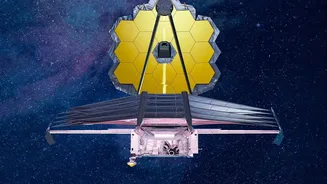
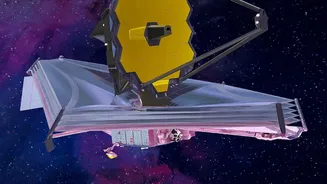
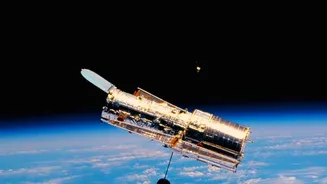
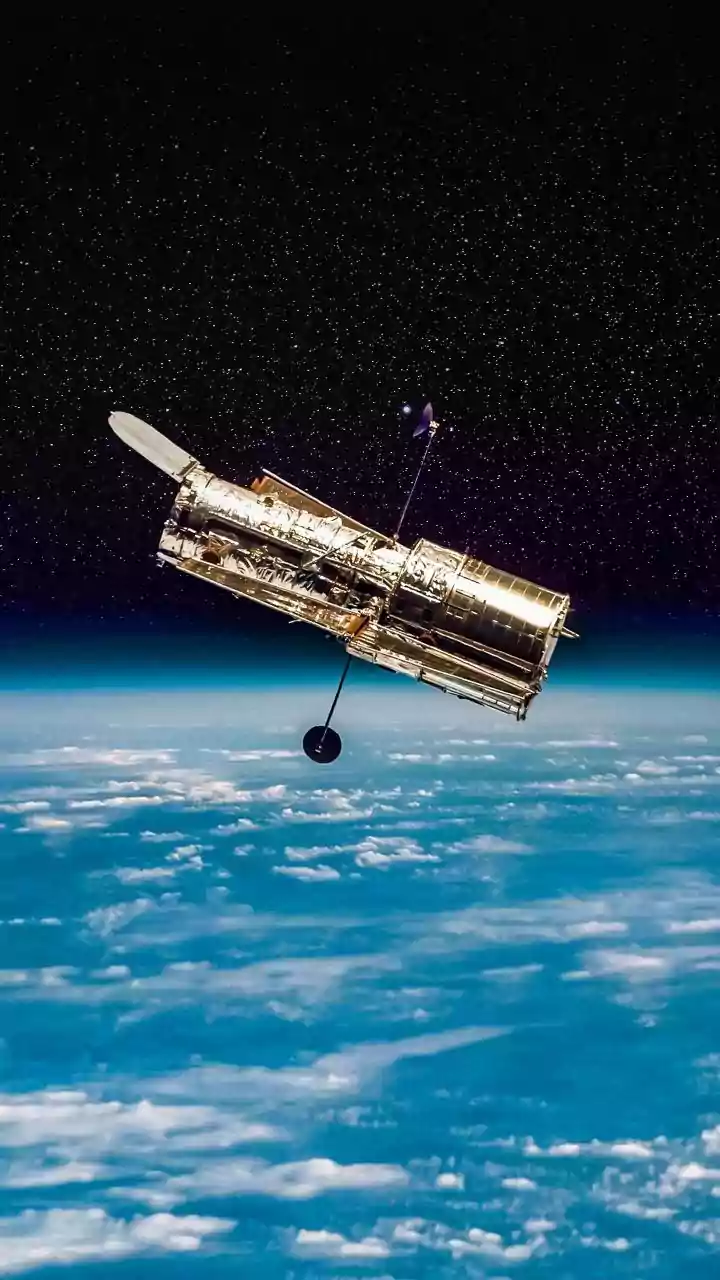
As the starlight filters through the edge of the exoplanet's atmosphere, a tiny fraction of that light is changed. Different gases and molecules in the atmosphere absorb very specific colours, or wavelengths, of light. This is where a technique called transit spectroscopy comes in. Telescopes like the James Webb Space Telescope (JWST) are equipped with instruments called spectrographs. These act like a super-powered prism, splitting the incoming starlight into its full spectrum, a rainbow of colours. When scientists analyze this spectrum, they see that certain slivers of colour are missing. These missing pieces are absorption lines, and they act like a unique chemical barcode, telling us exactly which gases are present in the planet's atmosphere.
The Significance of Methane and Carbon Dioxide
Detecting just any gas isn't enough; scientists are looking for specific combinations that hint at life. The pairing of carbon dioxide (CO2) and methane (CH4) is a particularly compelling potential biosignature. On their own, both gases can be produced by geological processes like volcanoes. However, these two gases don't naturally coexist in large quantities for long. Methane is broken down by starlight, and the two gases can react with each other. Finding a lot of both in the same atmosphere suggests that something is actively and continuously replenishing them. This state of imbalance is known as atmospheric disequilibrium.
Building the Case for a Biosignature
On Earth, life is the primary source of this disequilibrium, constantly pumping out methane while other processes produce carbon dioxide. Therefore, finding a similar mix on a rocky planet in the habitable zone—where temperatures could allow for liquid water—is a tantalizing sign. To strengthen the case, scientists also look for what's not there. For instance, many non-biological processes that create methane also produce carbon monoxide (CO). If a telescope detects abundant methane and carbon dioxide but very little or no carbon monoxide, it makes a biological source much more likely. It's this combination of evidence that helps scientists distinguish a potentially living world from a geologically active but lifeless one.