


A Day Longer Than a Year
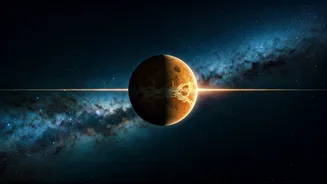
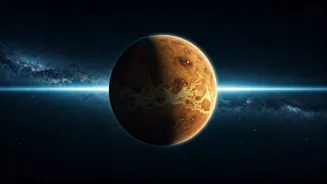
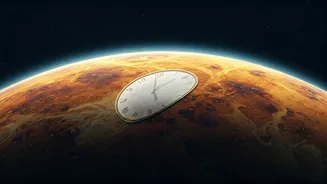
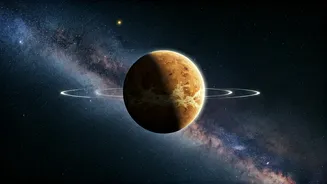
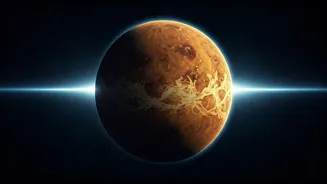
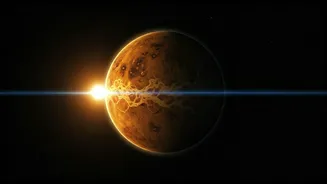
Let’s get the mind-bending numbers out of the way first. Venus takes about 225 Earth days to complete one orbit around the Sun—that’s its year. But it takes a staggering 243 Earth days to rotate just once on its axis. This means a single Venusian day is longer
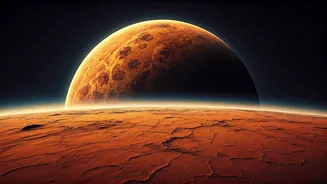
than a Venusian year. If you could stand on its scorching surface, you’d wait 117 Earth days between one sunrise and the next. This extreme slowness is an anomaly in our solar system. Earth zips around in 24 hours, and even the gas giant Jupiter, over 1,300 times Earth's volume, completes a rotation in under 10 hours. So why is our ‘sister planet’ the cosmic equivalent of a slow-motion film?
The Heavy Atmosphere Theory
One of the leading theories points to Venus’s monstrously thick atmosphere. Its atmosphere is about 90 times denser than Earth’s, composed almost entirely of carbon dioxide with clouds of sulfuric acid. This creates an extreme greenhouse effect, leading to surface temperatures hot enough to melt lead. Scientists believe this heavy, fast-moving atmosphere acts like a powerful brake. The immense friction between the solid planet and its thick, soupy atmosphere could be constantly slowing its rotation. Think of it like stirring a cup of thick honey; the resistance from the honey makes it much harder and slower to stir the spoon. For Venus, its atmosphere is the honey, and the planet itself is the spoon, being perpetually dragged to a crawl over billions of years.
A Violent Past or a Cosmic Tug-of-War?
Another possibility lies in Venus’s distant past. Some astronomers theorise that one or more massive asteroid impacts early in its history could have dramatically altered its spin, slowing it down or even knocking it into its current retrograde (backward) rotation. Unlike most other planets in our solar system, Venus spins clockwise. An impact of sufficient force could have acted as a catastrophic brake. A less violent but equally compelling idea involves tidal locking. Just as the Moon is tidally locked to Earth, always showing us the same face, Venus might be in a delicate gravitational tug-of-war. The Sun’s immense gravity pulls on Venus’s dense atmosphere, creating 'atmospheric tides' that could have contributed to slowing the planet’s spin to its current, lazy pace.
How We Measure a Planet's Pulse
Figuring this out isn't simple. Venus’s thick clouds make it impossible to see the surface with conventional telescopes. For decades, scientists have relied on bouncing radar signals off the planet's surface from Earth and from orbiting spacecraft like NASA's Magellan. By measuring the tiny Doppler shift in the returning radar waves, they can calculate the speed of the surface. Recent studies, using years of radar data, have refined our measurements to an astonishing degree. In 2021, a UCLA-led team determined the length of a Venusian day down to the millisecond. They also found that the planet's axis wobbles slightly, much like a spinning top, and that the length of its day seems to vary slightly. These subtle changes further support the idea that the dense atmosphere is interacting with the solid planet, influencing its spin.
Why This Cosmic Puzzle Matters for India
Understanding Venus's rotation isn't just an academic exercise. It holds clues to how planets form, why Earth and Venus turned out so differently, and the conditions that make a planet habitable. This puzzle is directly relevant to India’s space ambitions. ISRO’s planned Shukrayaan-1 mission aims to study the Venusian atmosphere and surface in unprecedented detail. By understanding the forces at play—from atmospheric dynamics to the planet’s internal structure—Shukrayaan-1 could provide crucial data to help solve the mystery of Venus's slow spin. Solving it would be a major step in understanding planetary evolution and could help us better identify habitable exoplanets in other star systems.