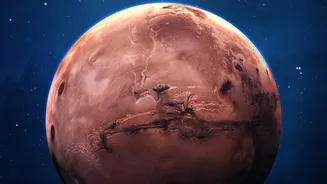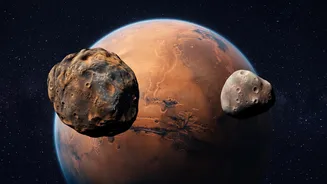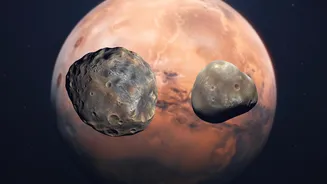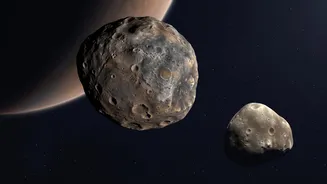

Mars has two tiny, potato-shaped moons, Phobos and Deimos, whose origins have long been a cosmic mystery. Their lumpy, non-spherical forms have puzzled scientists for decades, but new research is turning their unusual shapes into crucial clues.
Mars's Lumpy Companions
Unlike
Earth’s large, spherical Moon, the two moons of Mars are small and oddly shaped. Phobos, the larger of the two, is about 27 kilometres across at its widest point, while Deimos is roughly half that size. Both are too small for their own gravity to pull them into a round shape, a process that happens with larger celestial bodies. This has led them to be described as lumpy or potato-shaped. For years, their dark surfaces and irregular forms led to a leading theory: they were simply asteroids from the main belt between Mars and Jupiter, captured by the Red Planet's gravity long ago. This seemed like a neat explanation for their battered appearance.
A Flaw in the Capture Theory
While the captured-asteroid idea is simple, it has a major flaw: the orbits of Phobos and Deimos. Captured objects typically have wild, elliptical, and randomly tilted orbits. However, Mars's moons orbit in remarkably circular paths directly above the planet's equator. This tidy, orderly behaviour doesn't fit the chaotic profile of a captured asteroid. This orbital paradox has pushed scientists to look for alternative explanations for how these two peculiar moons came to be. The answer, many now believe, lies not in a gentle capture but in a far more violent event.
The Giant Impact Hypothesis
A leading alternative theory suggests that Phobos and Deimos are not foreign bodies but are instead native to Mars, born from a cataclysmic impact. Much like how Earth's Moon is thought to have formed from debris after a massive collision, scientists now propose that a dwarf-planet-sized object, perhaps as large as the asteroid Vesta, smashed into a young Mars billions of years ago. This impact would have blasted a massive amount of rock and debris into orbit, forming a ring around the planet. From this disk of material, multiple moons may have coalesced. According to simulations, larger moons would have formed closer to Mars and eventually spiraled back into the planet, leaving only the two small survivors we see today: Phobos and Deimos.
Clues Written on the Surface
The latest research focuses on how their shapes and surface features support this violent birth story. Recent analyses and simulations show that the composition of the moons seems to be a better match for Martian rock than for typical asteroids. One study, using data from the European Space Agency's Hera mission, explained Deimos's unusually smooth surface, which contrasts with the heavily cratered Phobos. They found that a single, large impact on Deimos could have created a massive crater at its south pole and simultaneously draped the entire moon in a thick layer of fine dust, or regolith, smoothing over older craters. This suggests Deimos may be a looselyheldtogether 'rubble pile', which is consistent with material clumping together in a postimpact debris disk.
What's Next for the Martian Moons
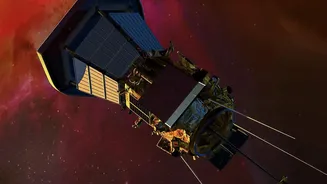
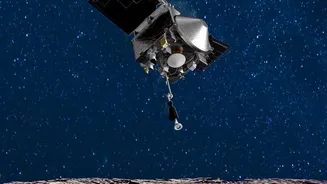
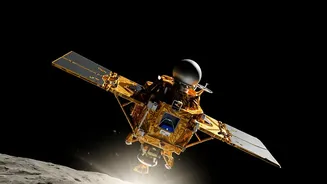
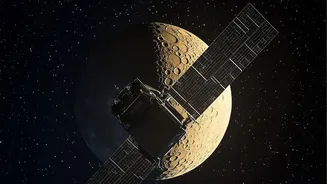
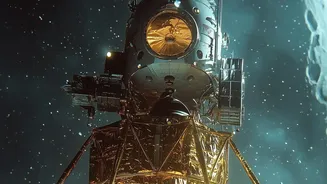
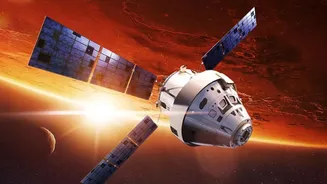
The debate is far from over, but the evidence is tilting away from the capture theory and towards the giant impact hypothesis. The final proof, however, will require getting our hands on the moons themselves. That’s the goal of the Japan Aerospace Exploration Agency’s (JAXA) Martian Moons eXploration (MMX) mission, which launched in late 2026. The spacecraft will visit both moons, land on Phobos, and collect samples to return to Earth. By analyzing these samples in labs, scientists will be able to determine their precise composition. If the material matches Mars, it will be strong evidence they were born from the planet itself. The mission could even collect Martian dust that has landed on Phobos over the eons, giving us a twoforone sample of both the moon and the Red Planet.