


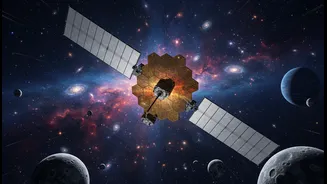



A Glimpse of a Cosmic Survivor
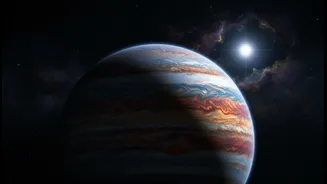
Imagine a world that has stared into the face of its own sun's death and lived to tell the tale. Astronomers are currently captivated by one such world, WD 1856 b, a gas giant several times more massive than Jupiter. What makes it so dramatic? It's orbiting
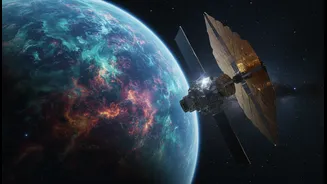
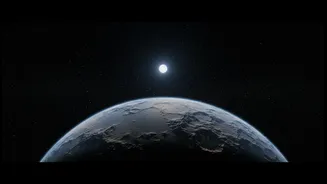
a white dwarf—the dead, dense core of a star that was once like our Sun. Billions of years ago, its star swelled into a red giant, an event that should have completely engulfed and destroyed a planet this close. And yet, WD 1856 b is still there, whipping around its dead star every 34 hours. Using the Webb telescope, scientists have studied the planet's atmosphere, finding it's much warmer than expected. The prevailing theory is that the planet must have migrated inward long after its star died, narrowly cheating death. It’s a ghost story and a preview of our own solar system's distant future, all rolled into one.
The Planet with an Impossible Atmosphere
Planetary science has some basic rules, and one of them is that small, scorching hot planets orbiting incredibly close to their stars shouldn't have atmospheres. The star's intense radiation should have blasted them away billions of years ago. But several planets are breaking this rule, creating major theoretical headaches. Take TOI-561 b, a so-called "hell planet" twice as old as our Sun with a surface likely covered in a magma ocean. By all accounts, it should be a bare rock. However, Webb’s observations suggest it is cloaked in a thick atmosphere. Another lava world, 55 Cancri e, appears to have an atmosphere that is constantly being replenished by gases released from its molten surface. This dynamic process of outgassing was just a theory before, but Webb's data suggests it's happening. These defiant worlds are forcing scientists to rethink how planets can form and hold onto their atmospheres in the most extreme environments.
Rewriting the Recipe for New Worlds
Perhaps the most fundamental drama is unfolding in the nurseries where planets are born. For decades, the standard recipe for making a habitable, rocky planet like Earth involved icy pebbles. The idea was that these pebbles, rich in water, would drift from the cold, outer regions of a protoplanetary disk toward the star, delivering water to the inner system. But Webb has found a planetary system in the making that seems to have skipped this ingredient. The disk around a star known as XUE 10 is bizarrely rich in carbon dioxide but has barely any detectable water where astronomers expect to find it. This discovery directly challenges prevailing formation models. Similarly, Webb recently got the first-ever detailed look at a moon-forming disk around an exoplanet and found its chemical makeup was completely different from the planet-forming disk around the host star—another new puzzle for theorists to solve.
The Healthy Drama of Scientific Debate
Not all the drama is in the data itself; some of it is in the scientific process it ignites. When Webb’s data hinted at a potential biosignature—a gas called dimethyl sulfide, produced by life on Earth—in the atmosphere of exoplanet K2-18b, headlines buzzed with excitement. But science demands extraordinary proof for extraordinary claims. Other scientists quickly used the same public data and, using different methods, could not confirm the detection, arguing the signal was not strong enough. This back-and-forth isn't a failure; it’s the scientific method working in real time. Meanwhile, Webb continues to create new mysteries. Very recent observations of Pluto and Saturn's moon Titan revealed a strange signal, suggesting the presence of an unknown molecule seen nowhere else. The telescope isn’t just answering old questions; it's providing thrilling new ones.