



A Signal from the Shadows
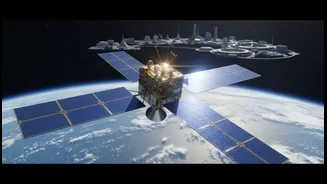
While much of the world remembers the Chandrayaan-2 mission for the dramatic landing attempt of its Vikram lander, the orbiter component has been quietly and diligently mapping the Moon from above. Using its sophisticated Dual-Frequency Synthetic Aperture
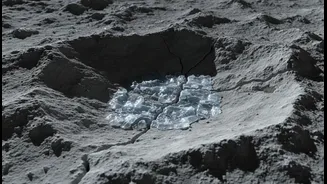
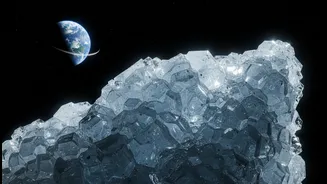
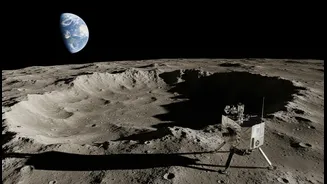
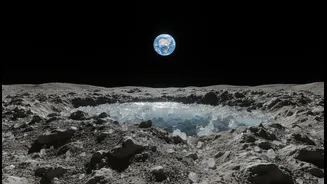
Radar (DFSAR), scientists have uncovered strong evidence of water ice hidden beneath the lunar surface. This isn't just a faint trace; the data points to significant deposits located in what are known as "doubly shadowed craters" near the Moon's south pole. These are craters within permanently shadowed regions where sunlight has not reached for billions of years, creating extreme deep-freeze conditions of around minus 248 degrees Celsius, cold enough to preserve ice indefinitely. The DFSAR instrument is uniquely suited for this task, using L-band and S-band frequencies to probe several metres below the regolith, or lunar soil, giving it the ability to see what other instruments could not.
The Ultimate Lunar Resource
The confirmation of accessible water ice is a game-changer for space exploration because of a concept called In-Situ Resource Utilization (ISRU), which essentially means living off the land. Launching materials from Earth is incredibly expensive; every kilogram costs thousands of dollars to escape our planet's gravity. If astronauts can source key materials on the Moon itself, it radically alters the economics and feasibility of long-term missions. Water is the most coveted of these resources. Beyond providing drinking water and supporting potential agriculture, it can be split into its constituent parts: oxygen and hydrogen. This gives astronauts breathable air and, most critically, the two primary components of rocket propellant. A Moon with its own refueling stations could become a launchpad for deeper solar system exploration, including missions to Mars.
A Strategic Advantage for India
This discovery, made possible by an Indian-built instrument on an ISRO mission, provides India with immense strategic capital in the new global space race. In recent years, the lunar south pole has become the most desirable real estate in the solar system, with nations like the US and China accelerating their own plans to explore the region for its resource potential. By identifying specific craters that likely hold subsurface ice—with one 1.1-kilometre-wide crater inside the larger Faustini crater showing particularly strong evidence—India is not just a participant but a key knowledge holder. This data is invaluable for planning future robotic and human missions, effectively giving ISRO a say in where the first lunar bases and mining operations might be established. It transforms India from an explorer into a potent architect of the future lunar economy.
From Detection to Drilling
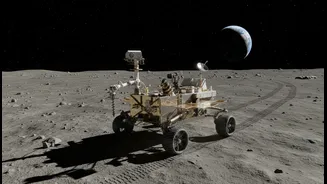
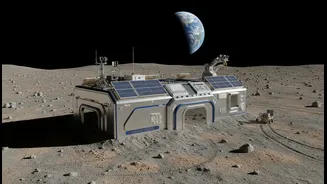
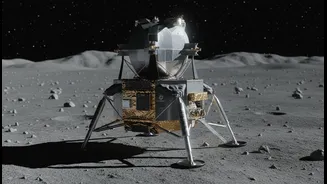
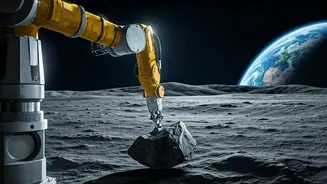
These radar observations are a monumental step, but they are just the beginning. The next phase of lunar exploration will focus on confirming these findings on the ground. This is where missions like Chandrayaan-4, a complex sample-return mission planned for around 2027, become crucial. The goal of Chandrayaan-4 will be to land, collect lunar soil and rock, and return it to Earth for detailed analysis. Furthermore, the joint ISRO-JAXA Lunar Polar Exploration Mission (LUPEX) is specifically designed to prospect for lunar resources. The insights from Chandrayaan-2 will directly inform the landing sites and scientific objectives for these future missions, creating a clear roadmap from detection to potential extraction. This feeds into India's ambitious long-term vision, which includes landing an Indian astronaut on the Moon by 2040 and eventually establishing a permanent lunar outpost.