




A New Eye on a Changing Planet
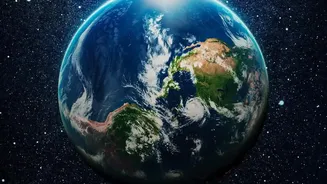
NASA, in collaboration with partners like IBM, has launched a groundbreaking initiative centered around a new artificial intelligence 'foundation model' named Prithvi, the Sanskrit word for Earth. This isn't just another algorithm; it's a new class of
AI designed to process and understand vast quantities of Earth observation data collected by satellites. The goal is to provide scientists, researchers, and policymakers with a more powerful and accessible tool to monitor our planet's complex systems. By making this technology open-source, NASA is inviting global collaboration, allowing anyone to use and adapt the model for their specific needs, from tracking deforestation in the Amazon to monitoring water resources in India. This open approach aims to accelerate scientific discovery and the development of real-world applications to address climate challenges.
How AI Joins the Climate Fight
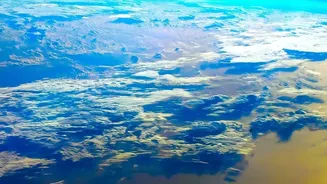
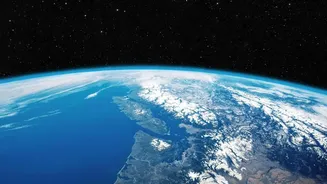
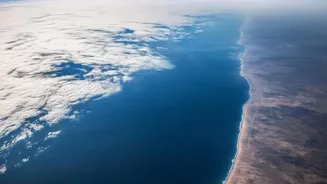
At its core, the Prithvi model is trained on decades of high-resolution satellite imagery from NASA and European Space Agency missions. Think of it as a student that has spent years studying pictures of the Earth, learning to identify everything from forests and farms to rivers and cities. This training allows the AI to spot patterns, changes, and anomalies that a human analyst might miss. A key innovation is the model's ability to act as a versatile 'base' that can be quickly fine-tuned for specific tasks. For example, after its general training, scientists can give it a small, labeled dataset—such as images of floodwaters—and the AI can then learn to accurately map flood plains anywhere in the world. This dramatically reduces the time and effort needed to develop custom AI solutions for environmental monitoring.
From Data to Disaster Prediction
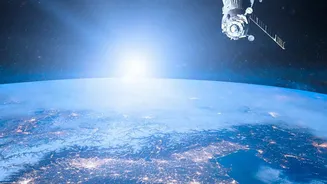
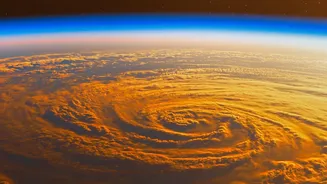
The potential applications are vast and carry significant weight for disaster-prone regions. The AI has already been tested for its ability to map burn scars from wildfires and detect changes in land use with remarkable accuracy. For India, this technology could be a game-changer. Imagine using the model to get more accurate, localized forecasts for the monsoon, predict the path of cyclones with greater lead time, or monitor the health of crops to improve food security. It can help track retreating glaciers in the Himalayas, monitor air quality over major cities, and provide critical data for managing water resources. Recently, a version of the model was successfully tested in orbit aboard the International Space Station, proving that this analysis can happen in real-time, delivering insights faster than ever before.
Beyond Geospatial Data
The initiative extends beyond just satellite images. A new version of the model, called Prithvi-Weather-Climate, has been trained on 40 years of atmospheric data. This model aims to improve weather and climate forecasting by uncovering complex patterns in temperature, pressure, and wind. Unlike many traditional models that require massive supercomputers, this AI can be fine-tuned and run on much smaller systems, making powerful forecasting tools more accessible globally. By improving the representation of atmospheric processes, it could lead to more reliable long-term climate projections and better short-term warnings for extreme weather events like heatwaves and intense rainfall.
Promise and Practical Hurdles
While the promise of AI in climate science is immense, it's not a silver bullet. The headline's use of "could" is important. The effectiveness of these models depends on the quality and availability of data. There are also challenges in ensuring the AI doesn't inherit biases from its training data, which could lead to inaccurate predictions for certain regions or phenomena. Some research also suggests that while AI excels at predicting known patterns, traditional physics-based models may still be better at forecasting record-breaking, unprecedented weather events. Therefore, the most powerful approach will likely be a hybrid one, where the speed and pattern-recognition of AI complements the foundational understanding of physics in traditional models, a view shared by many meteorologists.