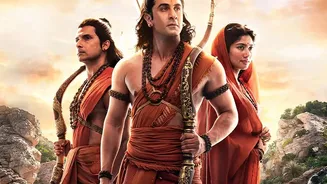









Nitesh Tiwari’s mythological epic ‘Ramayana’ is not just a film; it is a full-blown cultural event. Smashing records daily, the movie is on a historic box office run, demonstrating the immense power of combining an ancient story with modern scale.
A Box Office Juggernaut
Since
its release on November 5, ‘Ramayana: Rise of a Legend’ has dominated the global box office. In just 18 days, the film has amassed a staggering ₹1,693.50 crore in worldwide gross earnings, with trade analysts predicting it will cross the ₹1,700-crore mark shortly. The film's domestic performance has been equally impressive, with a total net collection of ₹942.75 crore in India. Its performance has been robust across all languages, proving the film's wide-reaching appeal. The Hindi version leads the charge, but the Malayalam, Kannada, and Tamil dubbed versions have also posted significant numbers, highlighting the success of its multilingual release strategy. This momentum makes director Nitesh Tiwari the only Indian filmmaker to have two films gross over ₹1,500 crore globally, the first being his 2016 blockbuster 'Dangal'.
The Power of a Pan-Indian Strategy
The incredible success of 'Ramayana' is a testament to the power of the 'pan-Indian' film model. This strategy involves planning a project from its inception as a nationwide release, rather than dubbing a regional film as an afterthought. By casting stars from different industries—Ranbir Kapoor from Hindi cinema, Yash from the Kannada industry, and Sai Pallavi, who works across Tamil, Telugu, and Malayalam films—the makers created a project with inherent appeal across multiple states. This approach dissolves the traditional boundaries between Bollywood and South Indian cinema, creating a unified Indian film market. The film was released simultaneously in Hindi, Tamil, Telugu, Kannada, and Malayalam, allowing audiences everywhere to experience the phenomenon together and generating massive, unified buzz.
Global Ambition and Technical Grandeur
From the beginning, ‘Ramayana’ was envisioned as India’s most ambitious attempt to create a global blockbuster. Produced by Namit Malhotra of DNEG, the visual effects powerhouse behind Hollywood hits like 'Dune' and 'Inception', the film boasts technical sophistication on a scale rarely seen in Indian cinema. The ambition extended to the soundtrack, with a historic collaboration between two-time Oscar winner Hans Zimmer and Indian musical legend A.R. Rahman. This commitment to world-class production values has paid off handsomely in overseas markets, where the film has earned ₹567 crore. It has already set a new record for Indian films at the U.S. box office, grossing $28 million in North America alone. Global distribution by major players like Sony Pictures has also been key to reaching both diaspora and non-Indian audiences.
A Timeless Story for a New Generation
At its core, the film's phenomenal success comes from the enduring power of its source material. The Ramayana is an epic revered by billions, and its themes of duty, sacrifice, and the battle between good and evil are timeless. Director Nitesh Tiwari, who spent over a decade in pre-production to ensure authenticity, has stated his goal was not to modernise the epic but to remind the world of its universal values. The casting was crucial to this vision. Tiwari chose Ranbir Kapoor for his ability to portray Lord Rama's quiet strength and contained pain. The combination of a faithful yet grand retelling of the story has resonated deeply with audiences, who have shown sustained interest well into the film's third weekend, with ticket sales continuing to surge.