
The Universe's Expected Childhood
For decades, the standard story of the early universe was one of gradual growth. The prevailing theory, known as the Lambda-CDM model, suggested that after the Big Bang, matter slowly came together. It predicted that the first galaxies would be small,
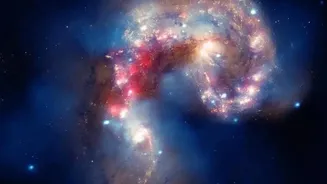
clumpy, and disorganized collections of young stars. These 'proto-galaxies' would then spend hundreds of millions of years merging and colliding, slowly building up into the grand, structured galaxies we see today, like our own Milky Way. Think of it like tiny hamlets and villages gradually connecting and expanding over a vast period to form a sprawling megacity. This model was based on the best data available, primarily from the Hubble Space Telescope, which gave us incredible views but had its limits when peering into the most distant, earliest epochs of time.
Webb's Surprising Family Album
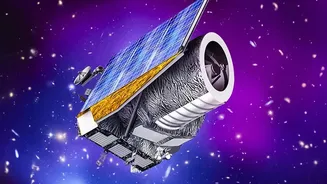
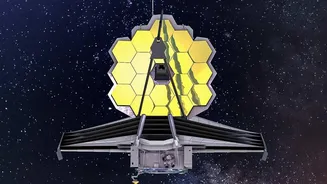
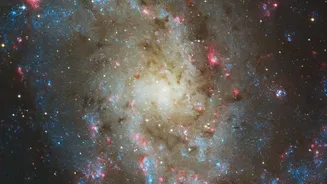
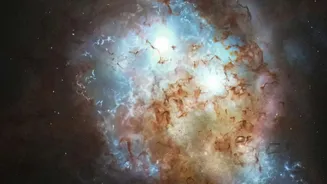
Then came the JWST, and the family album of the early universe got a lot more interesting. Thanks to its ability to detect faint infrared light, Webb can see objects whose light has been traveling for over 13 billion years. Programs like the JWST Advanced Deep Extragalactic Survey (JADES) are discovering hundreds of galaxies from when the universe was just 300 to 600 million years old. Instead of the expected small, messy galaxies, Webb is finding objects that are shockingly massive and surprisingly mature. Some appear to have developed complex structures, like discs, and contain populations of older stars far earlier than any model predicted was possible. It was as if, just a few years after the first villages were supposedly founded, a fully formed, brightly lit metropolis already stood.
The Mystery of the Red Dots
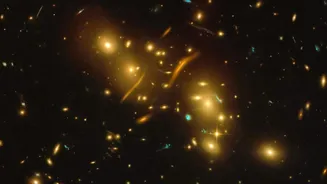
A key piece of this puzzle comes from understanding 'redshift'. As the universe expands, it stretches the wavelength of light traveling through it. Light that was originally blue or ultraviolet from a very distant object gets stretched into the red and infrared part of the spectrum by the time it reaches us. The more distant the object, the greater its redshift. Webb is finding numerous 'little red dots'—extremely high-redshift galaxies. Spectroscopic analysis has confirmed some of these, like JADES-GS-z14-0, existed when the universe was only about 290 million years old, or 2% of its current age. The startling thing isn't just their age, but their brightness and mass. They appear to be crackling with intense bursts of star formation, far more prolific than what was thought possible in such a young cosmos.
Rewriting the Cosmic Playbook
So, do these discoveries break our fundamental understanding of the universe? Most cosmologists say no—the Big Bang theory itself remains secure. However, these findings are forcing a major revision of the chapters on galaxy formation. The 'wiggle room' in the old theories is getting squeezed. Scientists are now exploring new possibilities. Perhaps the efficiency of star formation was much higher in the dense, early universe. Or maybe the way gas collapses to form stars and the way galaxies accumulate mass happens much faster than our simulations accounted for. The ingredients in the cosmic recipe seem right, but the cooking instructions are clearly in need of an update.
An Unexpected Black Hole Twist
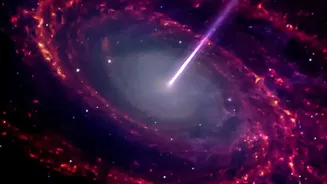
Adding another layer of complexity is the discovery of unexpectedly massive black holes at the centers of these ancient galaxies. One, in a galaxy called CEERS 1019, existed just 570 million years after the Big Bang. While massive, it is surprisingly more similar in scale to our own galaxy's central black hole than the billion-solar-mass monsters previously found, suggesting black hole growth might be more varied than thought. Another recent find showed evidence of two black holes merging just 740 million years after the Big Bang. Previously, it was believed that supermassive black holes needed much more time to grow. These findings suggest that black holes and their host galaxies might grow up together, in a tight, synchronous dance from the very beginning of time.