



A Leap to Light Speed
Imagine upgrading your home internet from sluggish dial-up to ultra-fast fiber optics. That's the scale of the leap NASA is making with its Deep Space Optical Communications (DSOC) technology. For years, space missions have relied on radio frequency (RF)
systems to send data back to Earth. While reliable, RF technology is like a narrow pipe, limiting the amount of information that can be sent at once. This results in long download times for high-resolution images and makes streaming video from, say, Mars, a practical impossibility. Laser communications, however, use near-infrared light to encode data, packing information into much tighter waves. This allows for data rates that are 10 to 100 times higher than the best radio systems, fundamentally changing how we can interact with spacecraft across the solar system.
The Psyche Mission's Historic Test
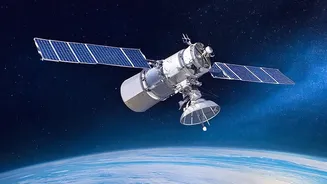
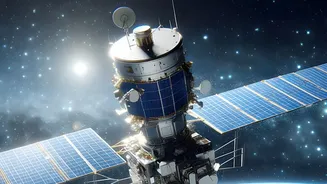
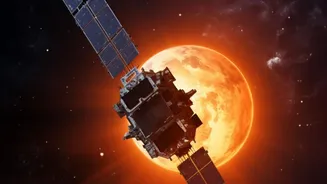
The technology had its most impressive demonstration aboard NASA's Psyche spacecraft, launched in October 2023 to study a unique metal-rich asteroid. While the spacecraft's primary mission won't be complete until it reaches its target in 2029, the DSOC experiment onboard has already achieved monumental success. In a landmark test, DSOC beamed a 15-second, high-definition video of a cat named Taters from a distance of 19 million miles (31 million kilometers) back to Earth. The video, a playful nod to early television test broadcasts, was transmitted at a maximum rate of 267 megabits per second (Mbps)—a speed comparable to many home broadband connections. It took just 101 seconds for the laser signal to travel across the vastness of space to be received by the Hale Telescope at Caltech's Palomar Observatory.
How Does Laser Communication Work?
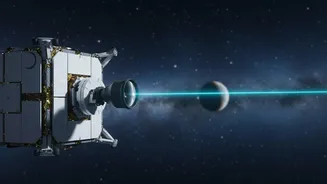
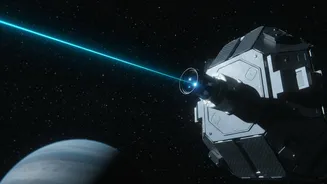
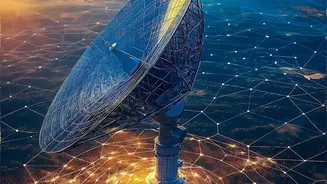
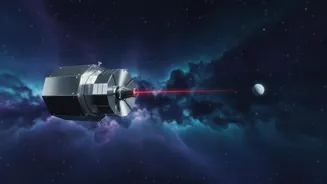
The system involves a sophisticated three-part architecture. First, a flight laser transceiver on the spacecraft, which includes an 8.6-inch telescope, emits the encoded near-infrared laser beam. This beam is incredibly narrow, which is key to its efficiency but also presents a major challenge: pointing it with extreme precision across millions of miles. Back on Earth, a powerful ground-based laser at a facility like the Table Mountain Observatory in California sends up a beacon for the spacecraft to lock onto. Once locked, the spacecraft transmits its high-rate data downlink to a massive receiver, like the 200-inch Hale Telescope. This telescope collects the faint laser photons, which are then processed by highly sensitive superconducting detectors that decode the information.
Pushing the Boundaries of Space and Time
The DSOC experiment continued to shatter records as the Psyche spacecraft traveled farther away. Even as the distance increased, the system proved its worth. At one point, it successfully transmitted data from a staggering 226 million kilometers away at a rate of 25 Mbps, still far exceeding what traditional radio could accomplish. The test mission, which concluded in September 2025 after two years of operations, surpassed all of its technical goals, exchanging signals from as far as 350 million kilometers. In total, the experiment successfully transmitted 13.6 terabits of data, proving the technology is a reliable and robust solution for future interplanetary missions.
A New Era for Science and Exploration
The implications of this technology are immense. Higher bandwidth means scientists can receive vastly more data from their instruments, leading to more detailed discoveries. Future missions could send back high-resolution, 3D maps of planetary surfaces or stream live, 4K video from a Mars rover. This capability will be crucial for future human missions to the Moon and Mars, where reliable, high-speed communication will be essential for astronaut safety and mission operations. By proving the viability of laser communications, NASA has paved the way for a future where the solar system feels just a little bit closer, with cosmic events unfolding on our screens in crystal-clear high definition.