




What Exactly Is the Tachocline?
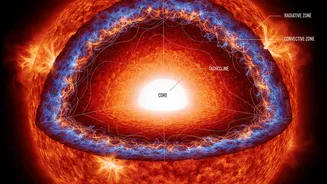
Imagine two different parts of a giant spinning ball moving at completely different speeds. The Sun's interior has a similar structure. The inner part, known as the radiative zone, rotates like a solid, rigid body. The outer layer, the convection zone, is
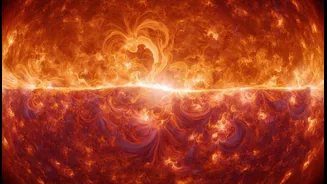
a turbulent sea of hot plasma where the equator spins much faster than the poles—a phenomenon called differential rotation. The tachocline is the incredibly thin, intensely sheared boundary separating these two regions. First proposed in 1992, it is believed to be less than 5% of the Sun's radius, located about 200,000 kilometres below the surface. This interface is where the calm, solid-body rotation of the deep interior grinds against the chaotic, differentially rotating plasma of the outer layers, creating immense physical stress.
The Evidence: How We See the Unseeable
Since the tachocline is hidden deep within the Sun, it cannot be observed directly. Scientists rely on a remarkable field called helioseismology, which is the study of 'sunquakes'. The Sun's surface constantly vibrates from sound waves that are generated by the turbulence in the convection zone and reverberate through its interior. By studying how these sound waves travel, scientists can map the Sun's inner structure, much like geologists use seismic waves from earthquakes to understand Earth's core. These helioseismic observations revealed the abrupt change in rotation speed, providing the first concrete evidence for the tachocline's existence and allowing scientists to measure its location and thickness.
The Opportunity: Unlocking the Sun’s Secrets
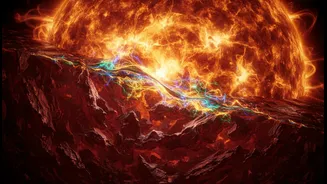
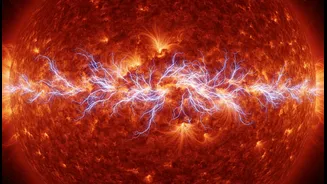
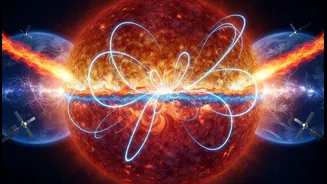
The tachocline isn't just a curiosity; many scientists believe it is the birthplace of the Sun's powerful magnetic field. The immense shear at this boundary is thought to act as a 'dynamo', stretching and amplifying weak magnetic fields into powerful, rope-like structures. These magnetic flux tubes can become unstable, rise through the convection zone, and burst through the surface to create sunspots. Understanding the tachocline is therefore a massive opportunity. A deeper knowledge of its dynamics could dramatically improve our ability to predict the solar cycle, including the timing and intensity of solar flares and coronal mass ejections (CMEs). Better 'space weather' forecasts would be a huge benefit, helping to protect our satellites, power grids, and communication systems from damaging solar storms.
The Limits: A Frontier of Solar Physics
Despite its importance, the tachocline remains one of the most puzzling regions of the Sun. Its very thinness is a major enigma; models suggest such a high-shear layer should spread out over time, yet it remains sharply defined. Scientists are still debating the exact mechanisms that keep it so confined, with theories involving magnetic fields and complex fluid dynamics. Furthermore, while helioseismology gives us a broad picture, it lacks the resolution to see the fine details of the turbulence and magnetic processes happening within the layer itself. Our understanding is limited by the fact that we are observing its effects from afar, relying on computer simulations and theoretical models to fill in the gaps. Key questions remain about how its shape and properties might subtly change over a solar cycle, and how exactly it generates the massive magnetic structures that dictate solar activity.