




A New Eye on the Cosmos
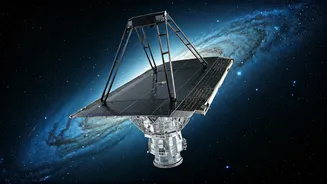
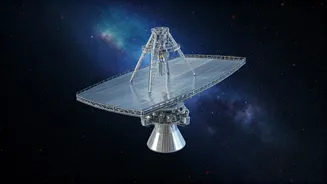
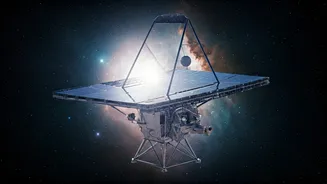
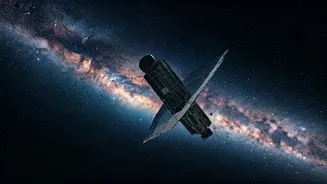
Scheduled to launch by late 2026, the Nancy Grace Roman Space Telescope is the next great observatory in NASA's lineup, but it’s not just a successor to Hubble or the James Webb Space Telescope (JWST). While its 2.4-meter mirror is the same size as Hubble's,
Roman's power lies in its immense field of view. Its Wide Field Instrument can capture an area of the sky 100 times larger than Hubble can in a single shot. This makes it a revolutionary survey telescope, designed to map vast stretches of the cosmos with incredible speed and precision. While Webb excels at detailed, deep dives into specific targets, Roman will create enormous cosmic panoramas, enabling scientists to perform a massive census of galaxies and stars, and in the process, hunt for planets in a completely new way.
The Power of Gravitational Microlensing
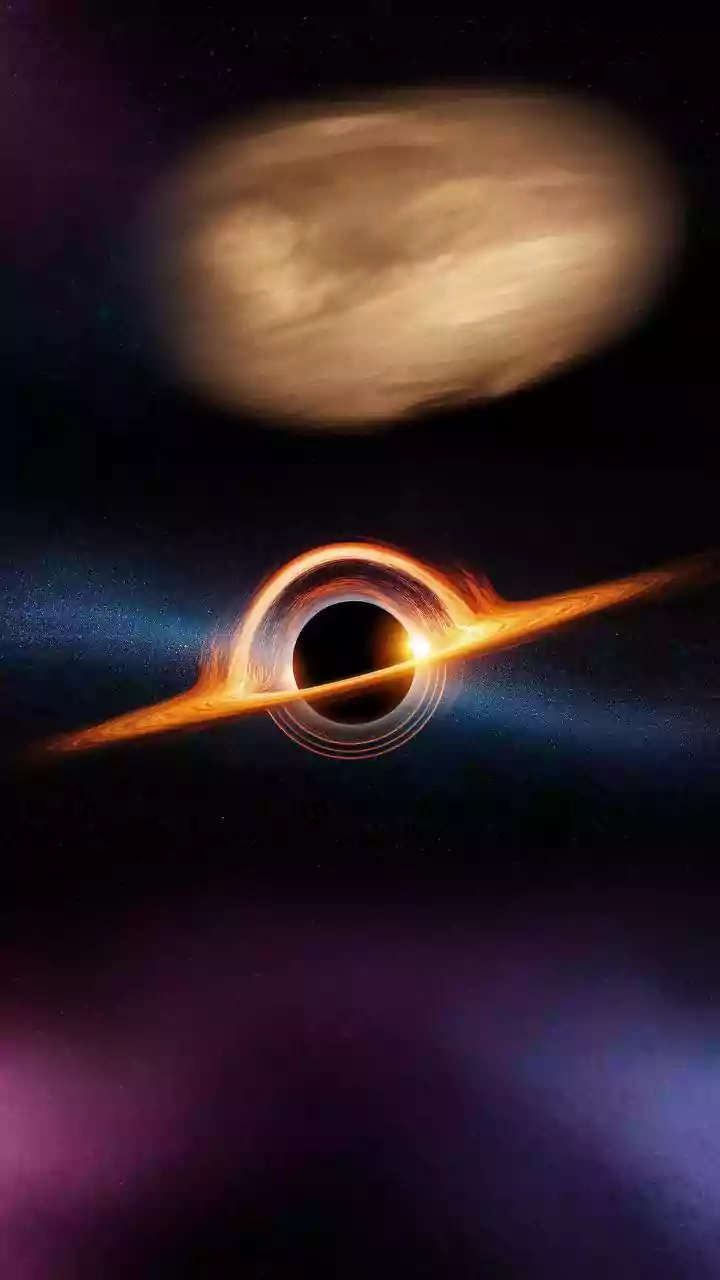
The secret to Roman’s planet-hunting prowess is a technique called gravitational microlensing. Predicted by Einstein's theory of general relativity, this phenomenon occurs when a massive object, like a star or planet, passes almost directly in front of a more distant star from our viewpoint. The foreground object's gravity acts like a natural magnifying glass, bending and amplifying the light from the background star, causing it to temporarily brighten. If the foreground star has a planet, the planet's own gravity creates a second, smaller spike in brightness—a tell-tale blip that signals its existence. This method is unique because it doesn't depend on the light from the exoplanet itself, allowing Roman to detect worlds that are too dim or too far from their star to be found using other common methods like the transit technique.
Finding the Galaxy's 'Rogue' Planets
One of the most exciting prospects for the Roman mission is its ability to find 'rogue' planets—worlds that drift through the galaxy untethered to any star. These free-floating planets are nearly impossible to detect with traditional methods because they emit no light of their own and don't orbit a star that they can transit. However, microlensing is perfectly suited for this task. Since the technique relies only on the object's mass warping spacetime, even a dark, lonely planet can create a detectable microlensing event if it passes in front of a background star. Roman's survey of the dense star fields toward the center of our galaxy will monitor hundreds of millions of stars, giving it the best chance yet to find and count these ghostly worlds, potentially discovering thousands and helping scientists understand how common they really are.
A More Complete Census of Planetary Systems
Current exoplanet detection methods have biases; the popular transit method, for instance, is best at finding large planets in tight, close-in orbits. This means our current catalog of over 5,500 exoplanets, while impressive, gives us an incomplete picture. Microlensing is most sensitive to planets at a greater distance from their star, from the habitable zone outwards to the icy realms of gas giants. Roman is expected to find planets with masses as low as Mars, discovering analogs to nearly every planet in our own solar system. In addition to using microlensing, Roman will also use the transit method and is expected to find around 100,000 transiting planets. The mission will also feature a Coronagraph Instrument, a technology demonstration designed to directly image Jupiter-sized exoplanets by blocking the host star's overwhelming glare.
Beyond Planets: Unraveling Cosmic Mysteries
While its exoplanet survey is a headline-grabbing feature, Roman’s mission is even broader. In fact, its primary goal is to address fundamental questions about dark energy, the mysterious force causing the universe's expansion to accelerate. By observing distant supernovae and mapping the large-scale structure of the universe, Roman will provide crucial data to test our cosmological models. The telescope will also study a wide range of astrophysical phenomena, from stars in neighboring galaxies to the outskirts of our own solar system. By combining an unprecedented field of view with Hubble-like resolution, the Nancy Grace Roman Space Telescope is set to become a true discovery machine, offering new insights into the evolution of our universe and the worlds that populate it.