




A New Eye on the Cosmos
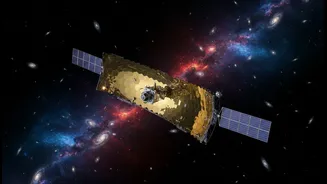
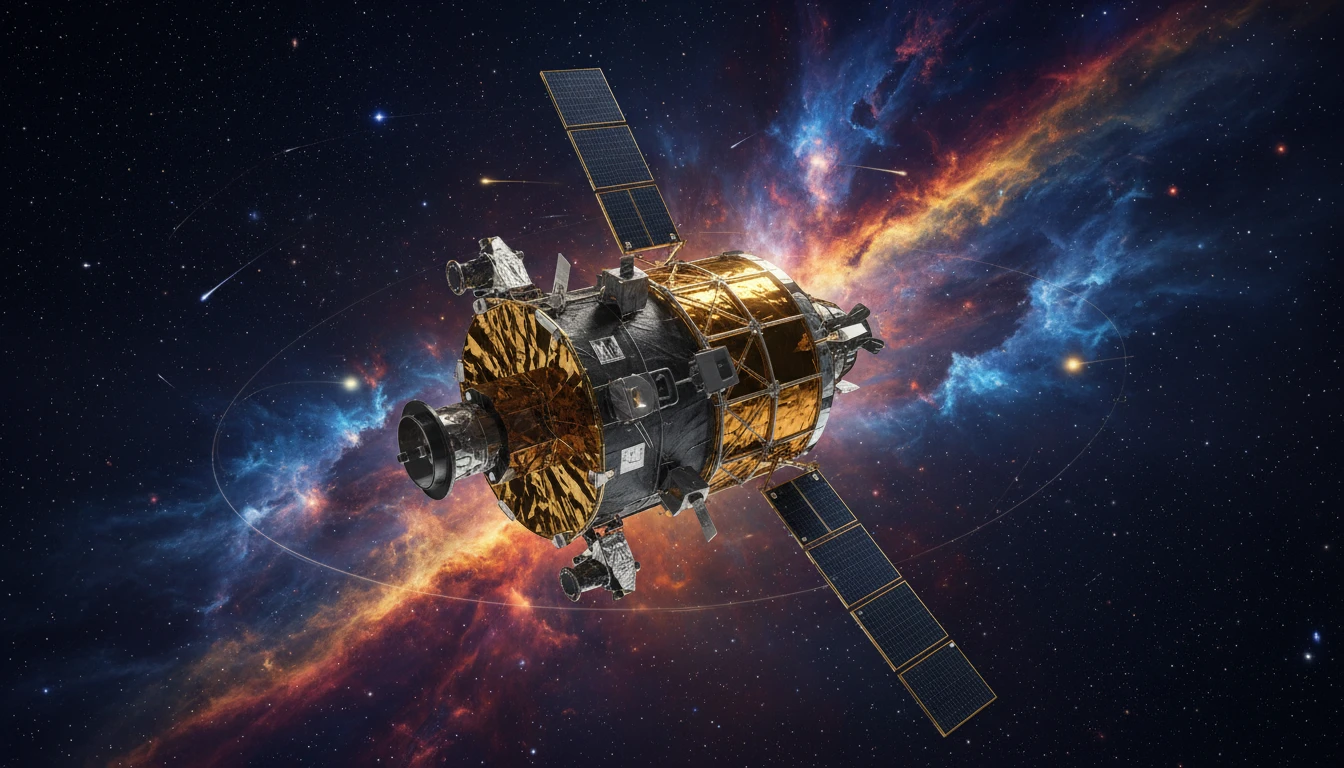
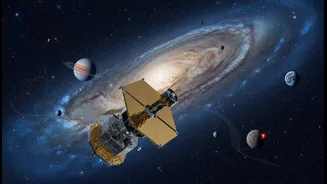
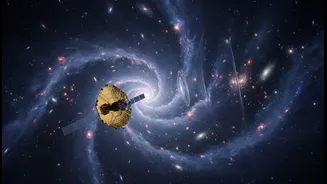
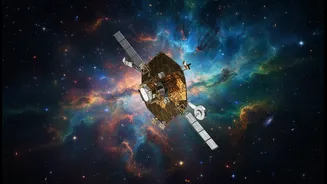
Set to launch in late 2026, the Nancy Grace Roman Space Telescope is NASA's next-generation flagship observatory. While the Hubble and James Webb telescopes are designed to stare deeply into small patches of the sky, Roman is built for breadth. Its primary
mirror is the same size as Hubble's, but its Wide Field Instrument gives it a panoramic field of view that is about 100 to 200 times larger. This incredible capability means Roman can survey the sky at speeds that were previously unimaginable, mapping huge swathes of the cosmos with the same high resolution as its predecessors. In just one year, it will gather more data than Hubble has in its entire multi-decade mission, creating enormous maps that will serve as a treasure trove for astronomers for years to come.
Hunting for the Universe’s Ghostly Skeleton
The “hidden structures” of the headline refer to the cosmic web—a gigantic, filamentary network of dark matter that is believed to form the underlying structure of the universe. Galaxies and galaxy clusters are not scattered randomly; they are thought to form along these massive, invisible threads, like beads on a string. Because dark matter doesn't emit or reflect light, this cosmic skeleton has been largely invisible to us. Roman will hunt for it indirectly through a phenomenon called weak gravitational lensing. As light from distant galaxies travels towards us, its path is slightly bent by the gravity of any matter it passes, including clumps of dark matter. By surveying billions of galaxies, Roman will map these subtle distortions in their shapes, allowing scientists to deduce the location and distribution of the dark matter that caused them, effectively drawing a map of this hidden architecture.
Solving the Dark Universe Riddle
Mapping the cosmic web isn’t just about creating a pretty picture; it’s central to solving two of the biggest puzzles in modern physics: dark matter and dark energy. Dark matter provides the extra gravity that holds galaxies together, while dark energy is the mysterious force causing the expansion of the universe to accelerate. By charting the evolution of the cosmic web and the distribution of galaxies over billions of years, Roman will test our fundamental theories about how these invisible forces have shaped the cosmos. One of its key methods will be to measure Baryon Acoustic Oscillations (BAOs), which are giant, ripple-like patterns in the distribution of galaxies left over from sound waves in the very early universe. These ripples expanded to a known size, and by measuring their apparent size at different cosmic epochs, astronomers can use them as a standard ruler to track the expansion history of the universe.
A Planet-Finding Powerhouse
Beyond its cosmological goals, the Roman mission is also a planet-hunting machine of unprecedented power. The mission is projected to discover thousands of new worlds outside our solar system, potentially doubling the number of known exoplanets. While previous missions like Kepler stared at nearby stars, Roman will look toward the dense starfields at the centre of our Milky Way galaxy. It will use a technique called gravitational microlensing, where a foreground star and its planets act as a natural lens, momentarily magnifying the light of a distant background star. This method is sensitive enough to find planets down to the mass of Mars, including free-floating “rogue” planets that don’t orbit a star at all. This galactic census will help scientists understand how common solar systems like our own are across different parts of the galaxy.