



The search for life beyond Earth is one of humanity's oldest questions. Today, scientists have a powerful tool that is bringing us closer to an answer: transmission spectroscopy. This technique allows us to peek into the atmospheres of distant worlds.
Reading an Atmosphere's Barcode
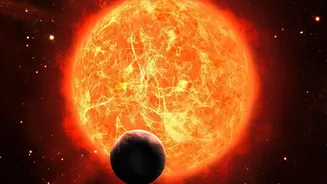
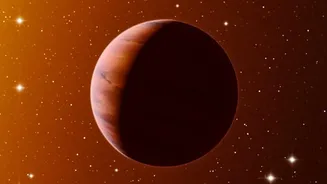
Imagine trying to figure out the ingredients of a cake by only looking at its shadow. It sounds impossible, but that’s the basic idea behind transmission spectroscopy. When a distant planet, or exoplanet, passes in front of its host star from our point of view—an event called a transit—a tiny sliver of starlight filters through the planet's atmosphere. By capturing this light, telescopes can analyse which 'colours' or wavelengths have been absorbed. Each gas in the atmosphere, like oxygen or methane, absorbs light at a unique set of wavelengths, creating a specific pattern of missing light, much like a barcode. By reading this barcode, astronomers can identify the chemical makeup of that planet's air, even from light-years away.
The Hunt for Chemical Fingerprints of Life
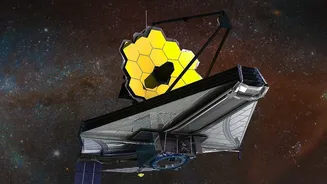
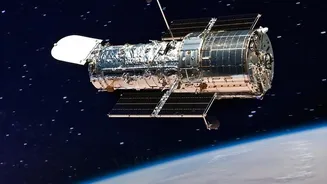
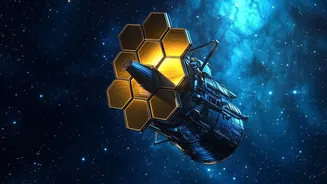
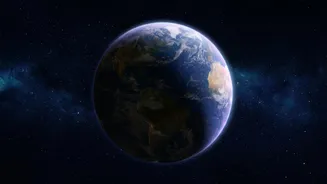
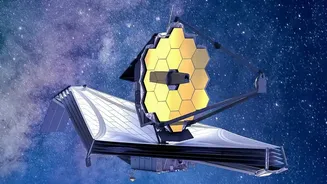
Not all gases are created equal. Some, known as biosignatures, are considered potential indicators of biological processes. On Earth, for example, the high concentration of oxygen is a direct result of photosynthesis from plants and microbes. Similarly, the simultaneous presence of gases that shouldn't coexist, like methane and oxygen, can signal a 'disequilibrium' that life might be actively maintaining. Transmission spectroscopy is adept at searching for these tell-tale molecules. The James Webb Space Telescope (JWST), with its incredible precision, can detect the faint absorption signals from gases like water vapour, carbon dioxide, and potentially even biosignatures like methane, in the atmospheres of distant worlds. This has pushed the search for extraterrestrial life into a new, evidence-based phase.
Why Is It the 'Gold Standard' Today?
While other methods for studying exoplanets exist, transmission spectroscopy has a key advantage for the technology we have right now. The main alternative, direct imaging, involves trying to capture an actual picture of the planet by blocking out the overwhelming glare of its star. This is incredibly difficult, as planets are billions of times fainter than their stars. While future telescopes are being designed for this, direct imaging is currently limited to very large, young, and hot planets far from their stars. Transmission spectroscopy, on the other hand, excels with the current generation of instruments like JWST. It is particularly effective for planets that orbit close to their stars, including potentially habitable worlds around smaller, dimmer stars, making a wider range of targets accessible for atmospheric study.
Challenges and the Path Forward
Despite its power, the method is not without its hurdles. The signals are incredibly faint, and factors like clouds or atmospheric haze can flatten the spectral 'barcode', making it difficult to read. Furthermore, scientists must be careful to rule out 'false positives'—geological or chemical processes that could mimic a sign of life without any biology involved. For example, oxygen can sometimes be produced abiotically by starlight breaking down water molecules. The activity on the host star itself can also contaminate the signal, making it tricky to distinguish between features in the star's light and the planet's atmosphere. This means that context is everything; a potential biosignature must be evaluated alongside everything else we know about the planet and its star.