
The Crucial Role of an Atmosphere
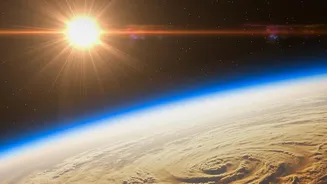
For a planet to be considered habitable, a stable atmosphere is non-negotiable. It provides the necessary pressure to maintain liquid water, shields the surface from harmful radiation, and regulates temperature. Without this gaseous blanket, a planet is just
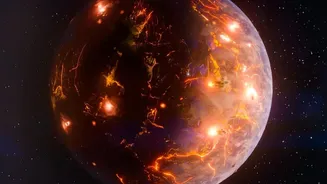
a barren rock, exposed to the vacuum of space. Scientists have long theorized about processes that cause planets to lose their protective layers, a phenomenon known as atmospheric escape. This can happen in several ways, from a slow thermal leakage of gases to a violent stripping process called hydrodynamic escape, where intense stellar radiation essentially boils the atmosphere away. Understanding these mechanisms is crucial, as they dictate whether a planet in the so-called "Goldilocks zone" is actually a paradise or a desolate wasteland.
Cosmic Forensics with Infrared Light
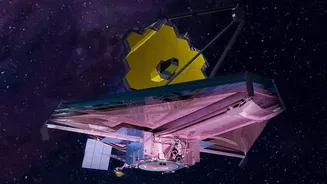
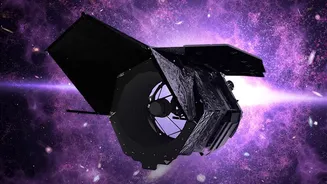
This is where the James Webb Space Telescope's powerful capabilities come into play. JWST uses a technique called transmission spectroscopy to analyze the light from a star as an exoplanet passes in front of it. As the starlight filters through the planet's atmosphere, different gases absorb specific wavelengths of light, leaving a unique chemical fingerprint. By studying this spectrum, astronomers can identify the components of the atmosphere, such as water, methane, or carbon dioxide. Crucially, they can also determine if there's an atmosphere at all. If the starlight passes through unchanged, it's a strong indicator that the planet has been stripped bare, providing direct evidence of atmospheric loss in action. This turns JWST into a cosmic detective, performing a forensic analysis on planets light-years away.
The Case of the TRAPPIST-1 System
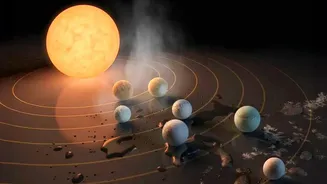
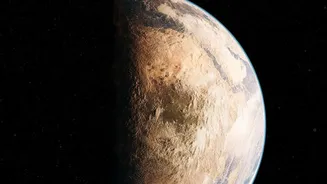
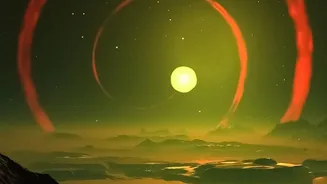
One of the most tantalizing targets for JWST has been the TRAPPIST-1 system, located about 40 light-years away. It features seven Earth-sized rocky planets orbiting a small, cool red dwarf star. Several of these planets are in the habitable zone, making them prime candidates in the search for life. However, recent observations have delivered a more complicated picture. Studies of the innermost planets, TRAPPIST-1b and TRAPPIST-1c, suggest they have little to no substantial atmosphere. Further studies of TRAPPIST-1d and TRAPPIST-1e have also produced sobering results, ruling out thick, Earth-like atmospheres and suggesting they may be bare rock. While this might seem like bad news, it's incredibly valuable data. It confirms that planets in the habitable zone can have their atmospheres completely eroded, likely due to the intense radiation from their host star.
Red Dwarfs: Cradles of Life or Cosmic Bullies?
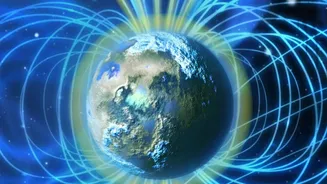
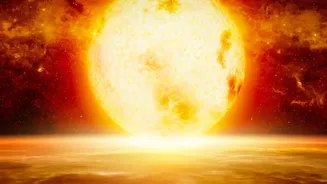
The findings from TRAPPIST-1 highlight a major debate in astrobiology: the habitability of planets around red dwarf stars. These stars are the most common in the galaxy, but they are also notoriously volatile, especially in their youth. They often unleash powerful flares and intense ultraviolet and X-ray radiation that can be devastating for the atmospheres of close-orbiting planets. Since the habitable zone around a cool red dwarf is much closer than it is for a star like our Sun, planets in this zone are particularly vulnerable to being scoured of their air. JWST's atmospheric loss data provides concrete evidence for this process. It suggests that for a planet around a red dwarf to be truly habitable, it might need specific protective factors, like a powerful magnetic field, or have formed at a time when its star was less active.