





Posture and Power Generation
The most obvious difference is your position: sitting in a kayak versus standing on a paddleboard. This fundamental distinction changes how you generate power and maintain balance. In a kayak, you are seated with your legs braced, creating a low and stable
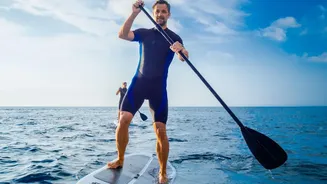
center of gravity. This position allows you to focus on rotational power. On a stand-up paddleboard, you are in a dynamic, upright stance. This requires constant micro-adjustments from the tiny muscles in your feet and legs to maintain balance, turning the activity into a full-body stability challenge before you even take a stroke. This standing position engages your entire core and lower body in a way that sitting does not.
The Kayak Stroke: A Rotational Push-Pull
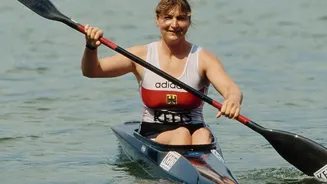
A common beginner mistake in kayaking is to 'arm paddle', using only the biceps and forearms to pull the double-bladed paddle through the water. This is inefficient and a fast track to shoulder strain. Proper kayaking technique is a full-body movement driven by torso rotation. As you plant one blade in the water, you should push with your opposite hand while rotating your core. The power comes from your larger back and core muscles, like the lats and obliques. Your arms and shoulders act more as a framework to transfer this power to the paddle. Think of your hands as hooks and your torso as the engine.
The SUP Stroke: A Full-Body Reach and Pull
Stand-up paddleboarding uses a longer, single-bladed paddle and involves a different set of mechanics. The stroke starts with reaching forward, hinging at the hips, and planting the paddle blade fully in the water. The power phase is not an arm pull; it's about engaging your lats and core to pull your body towards the paddle. Your top arm extends and pushes down on the handle for leverage, while your core and back do the heavy lifting. Because you're standing, your legs are also engaged, maintaining a slight squat for balance and power transfer. It's a true full-body workout that engages everything from your feet to your shoulders.
Shoulder Effort and Injury Risk
Both sports carry a risk of shoulder injury, but the nature of that risk differs. Shoulder pain is one of the most common complaints for all paddlers, often due to overuse or poor technique. In kayaking, the repetitive overhead motion, especially when done incorrectly by relying on arm strength, can lead to rotator cuff strain and shoulder impingement. The repetitive push-pull motion requires significant endurance from the shoulder muscles. With SUP, while the shoulders are heavily involved, the standing posture and core-driven stroke can distribute the load more broadly across the back and abdominal muscles. However, the combination of sustained leaning and trunk rotation can lead to lower back pain, and falls can cause acute injuries. Improper posture, like slouching, can also put undue pressure on the shoulder in either sport.
Making Your Choice
So, which is better for your shoulders? The answer depends on your technique and physical condition. Kayaking can be gentler on the lower back and requires less balance, making it a good choice if you want to focus on upper body and core rotation from a stable base. However, it places a high repetitive load on the shoulders if your form is poor. Stand-up paddleboarding offers a more complete, low-impact, full-body workout that heavily engages the core and legs for balance. The strain is distributed more widely, but it demands more from your balance and can be tough on the lower back. If you have a history of shoulder instability, proper SUP technique might feel more supportive, whereas if balance or lower back pain is your primary concern, a kayak with good back support could be the better option.