
An Alignment of Worlds
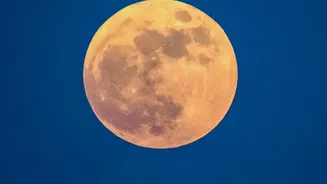
A total lunar eclipse can only happen during a full Moon, when the Sun, Earth, and Moon line up perfectly in that order. This alignment, known as syzygy, causes the Earth to cast its shadow directly onto the Moon, blocking the sunlight that normally makes
it shine. Earth's shadow isn't simple; it has two distinct parts. The outer, fainter shadow is called the penumbra, and the inner, darker core is the umbra. The type and appearance of the eclipse depend entirely on which part of this shadow the Moon passes through. While this alignment is required, we don't get a lunar eclipse every full Moon because the Moon's orbit is tilted by about five degrees relative to Earth's orbit around the Sun. Most of the time, the full Moon passes just above or below Earth's shadow.
Entering the Shadow
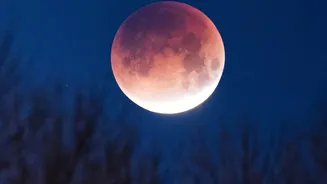
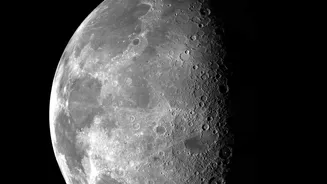
The show begins subtly. The first stage is the penumbral eclipse, which starts when the Moon enters Earth's faint outer shadow. To the naked eye, this phase is often so slight that most people won't notice a change. The real drama starts when the Moon begins to enter the umbra, the dark inner shadow. This is the beginning of the partial eclipse phase. Observers will see a dark 'bite' being taken out of the Moon's edge, which gradually grows larger over the course of about an hour. As more of the Moon slips into the umbra, the bright glare of the full Moon diminishes, making the sky darker and revealing nearby stars that were previously washed out.
The Spectacle of Totality
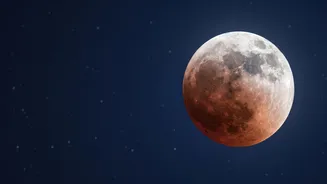
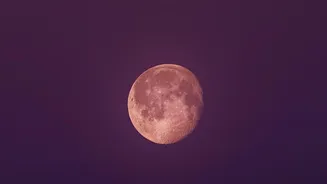
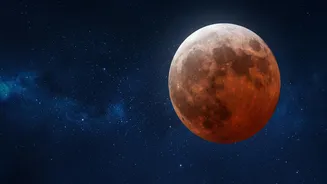
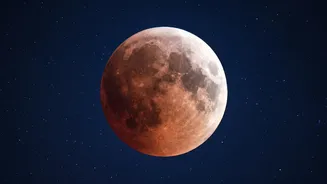
The climax of the event is totality, which begins the moment the Moon is fully engulfed by Earth's umbra. But instead of disappearing completely, the Moon often takes on a stunning new appearance. This is the moment it might glow with a coppery, orange, or deep red hue, earning it the popular nickname "Blood Moon." The duration of totality can vary significantly, lasting anywhere from a few minutes to over an hour, depending on whether the Moon passes through the center of the shadow or just skims its edge. During this phase, the Moon is lit by sunlight that has been filtered and bent by Earth's atmosphere.
The Science of the 'Blood Moon'
So, why does the Moon turn red? The phenomenon responsible is called Rayleigh scattering, the same process that makes our skies blue and our sunsets red. When sunlight passes through Earth's atmosphere, the gas molecules scatter shorter-wavelength light, like blues and violets, more effectively. Longer-wavelength light, like red and orange, passes through the atmosphere more directly. During a total lunar eclipse, this reddish light is bent, or refracted, around the edge of our planet and projected onto the lunar surface. In effect, you're seeing the light of all the sunrises and sunsets on Earth being cast onto the Moon at once. The exact shade of red depends on the state of Earth's atmosphere; a greater amount of dust or clouds can result in a darker, deeper red color.
Emerging Back into Light
Like a film played in reverse, the process unwinds after reaching its peak. Totality ends when the Moon's leading edge begins to move out of the umbra, and a sliver of bright, white light reappears on its surface. This marks the beginning of the second partial eclipse phase, as the dark shadow slowly recedes across the lunar disc. Over the next hour or so, the Moon gradually returns to its full, brilliant self. The final stage is once again a penumbral eclipse, as the Moon exits the last of Earth's faint outer shadow, a transition that is again very difficult to see. From start to finish, the entire celestial event can last for several hours.