



The Earthly Problem: Decoding Proteins
Many of the most challenging diseases, from cancer to neurodegenerative disorders, are linked to tiny, complex molecules called proteins. Proteins are the workhorses of our cells, but when they malfunction, they can cause serious health issues. To design
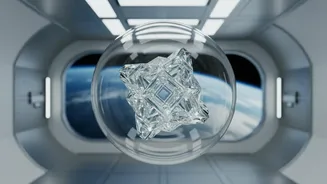
effective drugs, scientists need to understand a protein's intricate three-dimensional structure. This is often described as a 'lock and key' model; to create a drug (the key), you must first know the exact shape of the protein's active site (the lock). The best way to map a protein's structure is through a process called X-ray crystallography. However, this requires growing a near-perfect, highly ordered crystal of that protein, a task that has long been a bottleneck for researchers on Earth.
The Space-Based Solution: Crystal Growth in Orbit
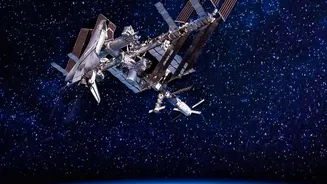
This is where orbital platforms like the International Space Station (ISS) come in. For decades, researchers have been sending protein samples into space, and the results are remarkable. In the microgravity environment, protein crystals can grow larger, more uniform, and with fewer imperfections than their terrestrial counterparts. On Earth, gravity causes two major problems. Firstly, sedimentation causes heavier crystal particles to fall out of solution. Secondly, convection currents in the fluid disturb the delicate, slow process of crystal formation. These forces can introduce defects into the crystal's lattice, making it harder to analyze. In space, these issues virtually disappear.
Why Zero Gravity is the Secret Ingredient
In the near-weightlessness of space, convection is suppressed, creating a stable environment where molecules can arrange themselves more slowly and precisely. As the crystal forms, it creates a 'depletion zone' around it—an area with a lower concentration of protein molecules. On Earth, convection currents would constantly stir this up. In space, this zone remains stable, allowing the crystal to grow in a slow, diffusion-limited process that results in a more ordered and perfect structure. This higher quality allows scientists to use X-ray diffraction to get a much clearer, higher-resolution map of the protein's structure, revealing details that would be invisible in crystals grown on the ground.
From Space Crystals to Targeted Drugs
This enhanced structural knowledge is already having a significant impact. Pharmaceutical giant Merck, for example, has used research aboard the ISS to improve its blockbuster cancer drug, Keytruda. Studies in microgravity helped the company develop a new formulation that can be administered as a simple injection instead of a lengthy intravenous infusion, dramatically improving the quality of life for patients. Research is ongoing for a wide range of diseases. Scientists have used space-grown crystals to study proteins related to Duchenne muscular dystrophy, gum disease, and tuberculosis. The ability to create better 3D cell cultures that more accurately mimic human tissues in space is also helping researchers test drug interactions and understand disease progression in new ways.
The Future of Orbital Pharmacies
The ISS has been the primary hub for this research, hosting hundreds of protein crystallization experiments for companies and academic institutions. But with the station scheduled for retirement around 2030, a new generation of commercial space ventures is stepping up. Companies like Varda Space Industries are developing their own autonomous, unmanned platforms specifically designed for in-orbit manufacturing, successfully growing drug crystals and returning them to Earth. Meanwhile, other firms are planning to launch commercial space stations that will include state-of-the-art life sciences labs, ensuring this vital research continues. These orbital platforms are becoming 'super accelerators' for drug development, moving space-based pharmaceutical research from theory to industrial application.