


The First Line of Defense: Optical Surveys
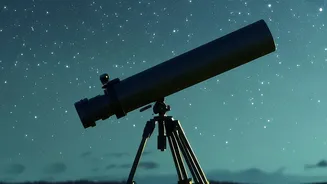
The hunt for potentially hazardous asteroids begins with wide-field optical telescopes. These are the workhorses of planetary defense, designed to scan enormous swathes of the night sky. Projects like the Catalina Sky Survey and Pan-STARRS take multiple
pictures of the same patch of sky minutes apart. Software then compares these images, searching for faint points of light that have moved against the fixed background of stars. This is how most near-Earth objects (NEOs) are first spotted. New facilities like the Vera C. Rubin Observatory are set to revolutionize this process, with the ability to discover millions of new asteroids and find a significant percentage of NEOs larger than 140 meters, a size that could cause significant damage. Once a potential object is flagged, the information is sent to the Minor Planet Center, a global clearinghouse for asteroid data.
From Faint Dot to Known Orbit
Finding a moving dot is just the beginning. To determine if it's a threat, astronomers need to calculate its orbit, and that requires more data. This is where 'follow-up' observations become crucial. A network of observatories around the world, including contributions from amateur astronomers, will track the new object over subsequent nights. Each new position measurement helps scientists at centers like NASA's Center for Near-Earth Object Studies (CNEOS) refine their calculations of the asteroid's trajectory. With enough data points, they can plot the asteroid's path for decades or even centuries into the future, determining if it will make any dangerously close approaches to Earth. This coordinated effort turns an anonymous speck of light into a cataloged object with a known path.
The Heavy Hitters: Radar Astronomy
While optical telescopes are great for discovery, radio telescopes provide the high-resolution details. Using a technique called radar astronomy, facilities like the Goldstone Solar System Radar in California can get a much closer look at an asteroid as it nears Earth. This is an active process: the telescope transmits a powerful radio signal toward the asteroid and then 'listens' for the echo. The time it takes for the signal to return reveals the asteroid's distance with incredible precision. Furthermore, by analyzing how the returning signal is spread out in time and frequency (a method called delay-Doppler imaging), scientists can create detailed 3D models. This reveals the asteroid's size, shape, surface features, and even how fast it's spinning—all critical information for assessing its potential impact risk and planning any mitigation efforts.
A Global, Coordinated Effort
No single telescope or country can monitor the entire sky alone. Tracking asteroids is a deeply collaborative, global enterprise. NASA's Planetary Defense Coordination Office (PDCO) works with international partners to ensure that data is shared and that potential threats are continuously monitored. This office helps coordinate the efforts of survey teams, follow-up observers, and radar facilities to build the most complete picture possible of the NEO population. When a potentially hazardous object is detected, this coordinated network ensures that timely and accurate information is available to assess the threat and, if necessary, prepare a response. The system is designed to turn individual discoveries into actionable intelligence for the entire planet.
Meeting the Challenge of Speed and Surprise
Fast-moving asteroids present a unique challenge. Some can be quite large and spin rapidly, completing a rotation in just a few minutes. Others may approach from the direction of the Sun, making them invisible to nighttime optical surveys until they are very close. The technology to meet these challenges is constantly evolving. New observatories like the Rubin Observatory promise to dramatically increase the rate of discovery, finding asteroids that are smaller and farther away. Meanwhile, new concepts for more powerful radar transmitters, like the proposed ngRADAR system for the Green Bank Telescope, could provide even higher-resolution images and more precise tracking, enhancing our ability to characterize these fast-moving targets. This constant innovation is vital for keeping our cosmic horizon secure.