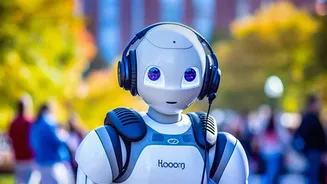







The New Digital Tutor
Artificial intelligence has rapidly moved from a futuristic concept to a daily reality for students. Platforms powered by large language models can explain complex theories, brainstorm essay topics, correct grammar, and even help debug lines of code.
For many, these tools are invaluable learning aids. A student struggling with a difficult physics concept can get an instant, simplified explanation. Another can use AI to outline a history paper or generate practice questions for an upcoming exam. In a survey of recent graduates, 71% reported using AI to help with their coursework, viewing it as a collaborator that improves productivity and time management. When used this way, AI acts as a partner, helping students clarify their thoughts and deepen their understanding of a subject.
The Slippery Slope to Shortcuts
The very features that make AI a great tutor also make it a tempting shortcut. The line gets blurry when “explain this concept” turns into “write my essay,” or “debug this code” becomes “write the entire program for me.” Relying on AI to generate complete assignments bypasses the learning process entirely. Educators report seeing an increase in submissions that lack originality, suggesting students are copying and pasting responses without engaging with the material. The University Grants Commission (UGC) in India has taken notice, issuing revised guidelines that treat the unacknowledged use of AI-generated content as plagiarism. Under these rules, submitting a thesis with significant AI-generated content can lead to severe penalties, including potential cancellation of PhD registration.
Is AI Eroding Critical Thinking?
Beyond academic integrity, there is a growing concern about the cognitive impact of over-relying on AI. Learning isn't just about finding the right answer; it's about the struggle—the process of analyzing a problem, forming a hypothesis, and developing an argument. When AI provides answers too quickly, it can prevent students from engaging in this essential cognitive struggle, potentially weakening their critical thinking and problem-solving skills. Studies have shown that while AI can reduce the mental load for tasks, students who used it heavily demonstrated poorer reasoning skills compared to those using traditional methods. The goal of education is to develop independent thought, and critics worry that excessive reliance on AI might create a generation of students who are skilled at prompting but not at thinking for themselves.
The Response from Indian Academia
Indian universities are working to adapt to this new reality. While many institutions are still developing formal policies, the consensus is that AI can be used to assist, but not replace, a student's own intellectual work. The UGC has advised universities to develop their own guidelines, emphasizing transparency and accountability; the student is always responsible for the final submission. Premier institutions like IIT Delhi are creating frameworks that encourage ethical use, such as requiring students to cite any AI-assisted content. Rather than banning the technology, educators are being encouraged to design assignments that can't be easily answered by AI, focusing instead on a student's unique analysis and critical perspective.
How to Use AI Ethically and Effectively
For students, the key is to treat AI as a partner, not a replacement. The intention behind its use matters most. Use it to brainstorm, not to write. Use it to understand a concept, not to get a final answer. Always fact-check AI-generated information, as these tools can be inaccurate or even invent sources. Transparency is crucial; if an instructor's policy is unclear, ask for clarification. Many educators advise students to disclose when and how they have used AI in their work. The aim is to use AI to augment your own intelligence, not to outsource your thinking. By using these tools responsibly, students can leverage their power without compromising their own learning and intellectual growth.