






From the blistering heat of summer to the cool relief of winter and the deluge of the monsoon, India's seasons define our year. But what causes this dramatic shift? The answer isn't what most people think, and it's all down to a wobble.
It All Starts with a Tilt
The secret to our
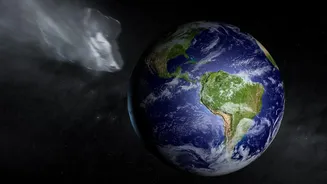
seasons lies not in how close we are to the Sun, but in the Earth's posture as it journeys through space. Our planet spins on an axis, an imaginary line running through the North and South Poles. However, this axis isn't perfectly upright. Instead, it's tilted at a steady angle of about 23.5 degrees. This tilt remains constant, pointing in the same direction towards the stars as we orbit the Sun. Imagine a spinning top that's leaning over slightly; that's our Earth. This simple tilt is the single most important factor in creating the changing seasons we experience. Some scientists believe this tilt was caused by a massive object, possibly the size of Mars, colliding with a young Earth billions of years ago.
Direct vs. Indirect Sunlight: The Real Heat Source
Because of this tilt, different parts of the Earth receive the Sun's energy at different angles throughout the year. Think of it like shining a torch on a wall. If you point the torch directly at the wall, you get a bright, concentrated circle of light. This is direct sunlight. The energy is focused on a small area, creating more heat. Now, if you angle the torch, the beam spreads out, covering a larger area but becoming much dimmer and less intense. This is indirect sunlight. When the Northern Hemisphere is tilted towards the Sun, as it is around June, places like India receive more direct rays. The Sun is higher in the sky, the days are longer, and the concentrated energy results in the heat of summer. Six months later, when the hemisphere is tilted away, the Sun's rays strike us at a shallower angle, spreading the same energy over a wider area and bringing the shorter days and cooler temperatures of winter.
Marking the Journey: Solstices and Equinoxes
The Earth's year-long orbit around the Sun is marked by four key moments caused by its tilt: two solstices and two equinoxes. The summer solstice, around June 21, is when the Northern Hemisphere's tilt towards the Sun is at its maximum. This results in the longest day of the year for us. Conversely, the winter solstice, around December 21 or 22, marks the point when we are tilted furthest away, giving us our shortest day of the year. The equinoxes, which occur around March 20 and September 22, are the halfway points. On these days, the tilt is neither toward nor away from the Sun, but sideways. The Sun shines directly over the Equator, and day and night are of roughly equal length all over the world. These four points define the astronomical beginning of each season.
Busting the Biggest Myth: It's Not the Distance
A very common misconception is that summer happens when the Earth is closer to the Sun and winter when it's farther away. While it's true that Earth's orbit is a slight oval, not a perfect circle, the change in distance is not significant enough to cause the seasons. In fact, the Earth is actually closest to the Sun in early January—a time when the Northern Hemisphere is deep in winter. And we are farthest from the Sun in early July, during the peak of our summer. This fact alone proves that the distance to the Sun is not the main driver of our seasonal temperatures. The opposite seasons experienced by the Northern and Southern Hemispheres at the same time further debunk this myth; if proximity were the cause, both hemispheres would have summer simultaneously.