


The Problem: A Spinning Planet
Photographing a faint, faraway nebula or galaxy requires leaving the camera's shutter open for a long time, sometimes for several minutes per shot. This allows the sensor to gather as much faint light as possible. But on a standard tripod, this creates
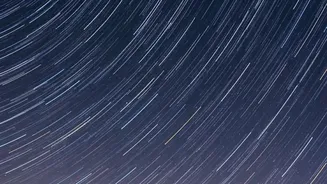
an immediate issue. Because the Earth is constantly rotating, celestial objects appear to drift across the night sky. A long exposure captures this movement, turning pinpoint stars into blurry streaks or trails. While beautiful in their own right, star trails are the enemy of deep-space imaging, where the goal is to see an object with pristine clarity. The challenge, then, is not just to point a camera at a target, but to track it perfectly as it moves across our field of view.
Two Ways to Track the Sky
There are two main types of motorised telescope mounts designed to follow celestial objects: Altitude-Azimuth (Alt-Az) and Equatorial (EQ). An Alt-Az mount is the most intuitive; it moves up and down (altitude) and left and right (azimuth), just like a standard camera tripod. While computerised Alt-Az mounts can track a star, they do so with a series of small up-down and left-right adjustments. This is perfectly fine for visual observing, where your eye won't notice the subtle mechanics. For short exposures of the Moon or planets, they also work well. However, for long-exposure deep-sky photography, this two-axis movement introduces a fatal flaw: field rotation.
The Trouble with Field Rotation
Field rotation is the reason Alt-Az mounts are unsuitable for serious deep-space astrophotography. Even if the mount keeps your target perfectly centred in the frame, the objects around that central point will appear to rotate over time. Think of watching a constellation like Orion rise: it appears on its side, stands upright as it crosses the sky, and then tilts the other way as it sets. An Alt-Az mount tracks the target but doesn't account for this change in orientation relative to your camera sensor. During a long exposure, this causes stars away from the centre of the image to form small, circular trails, smudging the very details you're trying to capture.
The Equatorial Mount's Elegant Solution
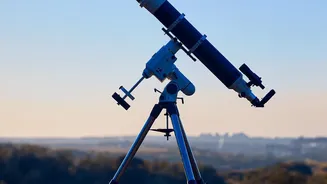
An equatorial mount solves the problem of Earth's rotation with an elegant design. Instead of moving flatly up-down and left-right, the entire mount is tilted so that one of its axes, the Right Ascension (RA) or polar axis, is parallel to the Earth's own axis of rotation. This process, called polar alignment, is the single most critical step in astrophotography. For observers in the Northern Hemisphere, this means pointing the RA axis directly at the North Celestial Pole, which is very close to the star Polaris. Once aligned, the mount no longer needs to make complex two-axis adjustments. It only needs to rotate along this one polar axis, at the exact same speed as the Earth but in the opposite direction, to perfectly counteract our planet's spin.
One Axis to Rule Them All
By aligning its main axis with Earth's, an equatorial mount makes the sky's complex arc-like motion simple. The mount has two axes: Right Ascension (RA) and Declination (Dec). These function like longitude and latitude for the sky. After pointing the telescope at a target using both axes, the mount only needs to turn the RA axis to track it. This single, smooth motion perfectly matches the movement of every star, galaxy, and nebula in the sky. Because the mount is rotating on the same plane as the celestial sphere, field rotation is completely eliminated. The orientation of everything in the frame remains constant, allowing for the long, pristine exposures needed for a crystal-clear image.