




A New Window into Cosmic Chaos
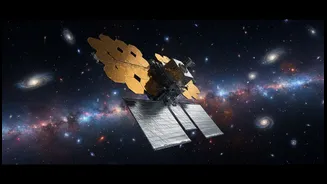
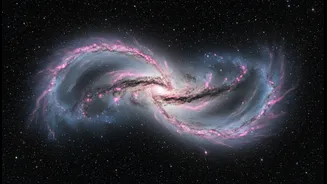
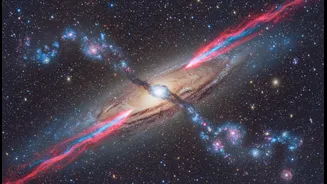
To celebrate its fourth year of science operations, NASA has released a jaw-dropping new portrait of Centaurus A. Where the Hubble telescope saw only obscuring bands of darkness, Webb's powerful infrared instruments, MIRI and NIRCam, have pierced through
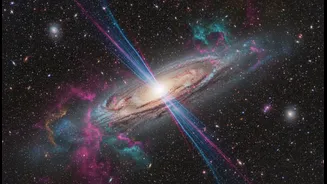
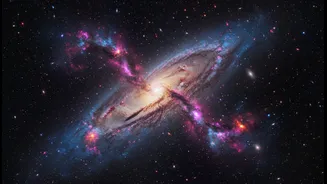
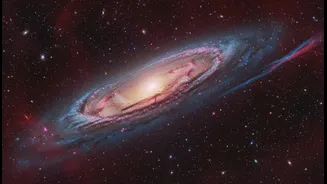
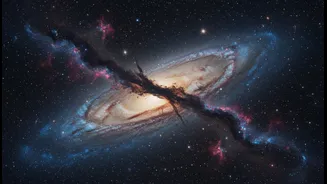
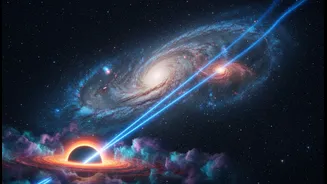
the thick cosmic dust. The result is a spectacular, intricate view of a galaxy in turmoil. We can now see the glowing filaments of warm dust, a warped, parallelogram-shaped band of gas at the galaxy's centre, and millions of individual stars that were previously hidden. The image reveals glowing reddish points, which are stellar nurseries where new stars are being born from the chaos, and the tell-tale signs of an active supermassive black hole at its core.
The Scars of an Ancient Collision
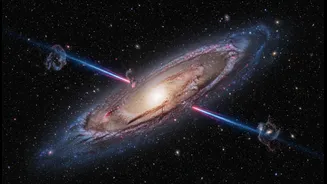
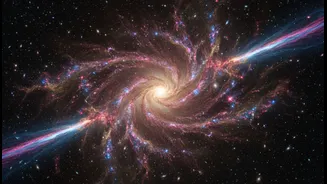
The strange, disturbed shape of Centaurus A is the result of a colossal merger. Astronomers theorize that roughly two billion years ago, a large elliptical galaxy collided with a smaller spiral galaxy. This event is not a gentle blending; it's an act of gravitational violence that rips apart existing structures and flings material across space. However, an interesting fact about these cosmic collisions is that individual stars almost never hit each other because the space between them is so vast. Instead, the huge clouds of gas and dust within the galaxies slam into each other. This compression triggers intense bursts of star formation, a phenomenon known as a 'starburst'. The collision also provides a fresh supply of material to feed the supermassive black hole at the galaxy's heart, which in turn unleashes powerful jets of energy that further shape its environment.
From Stardust to Your Morning Routine
This is where a distant galaxy crash starts to become personal. The process of destruction and creation seen in Centaurus A is fundamentally linked to our own existence. The elements heavier than hydrogen and helium—the carbon in our cells, the oxygen we breathe, the iron in our blood—were all forged inside stars. Those stars live, die, and sometimes are born from the recycled gas and dust churned up by events like galactic mergers. Starbursts, triggered by collisions, accelerate this cycle of cosmic recycling. In a very real sense, the chaotic process that Webb is now showing us with unprecedented clarity is a key part of the universe's mechanism for creating the ingredients necessary for planets and, eventually, life. The drama of Centaurus A is a snapshot of the same universal processes that ultimately allowed for your morning cup of coffee to exist.
A Lesson in Time and Perspective
Contemplating an event that happened millions of years ago, whose light is only just reaching us, offers a profound lesson in perspective. Our daily worries and urgent deadlines operate on a timescale of hours and days. The story of Centaurus A unfolds over billions of years. This immense difference in scale doesn't make our problems insignificant, but it can frame them in a new light. The universe is in a constant state of flux, of destruction and renewal, on a scale we can barely comprehend. The forces that tore apart and reshaped Centaurus A are the same fundamental laws of physics that govern our world. Seeing this process play out so vividly can be a powerful reminder of the impermanence and interconnectedness of everything, turning a 'daily issue' from a problem to be solved into a moment of reflection on the grand cosmic drama.
The Universe on Your Screen
Perhaps the most direct way galaxy collisions become a daily issue is through their sheer accessibility. Technology like the James Webb Space Telescope brings these once-abstract events directly to our screens in stunning, high-resolution detail. What was once the exclusive domain of astronomers is now a shared cultural experience. We can zoom in on the star-forming regions of Centaurus A on a laptop, or marvel at its ghostly dust lanes on a phone during a commute. This democratization of the cosmos turns astronomy into a source of daily wonder and continuous discovery, allowing us to carry a picture of our universe's violent, creative, and beautiful nature right in our pockets.