






The Billion-Dollar Threat Above
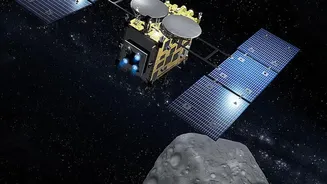
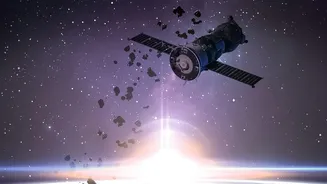
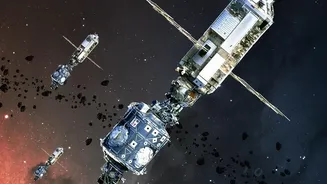
Imagine a highway where abandoned cars, stray tires, and tiny metal fragments are flying around at 28,000 kilometres per hour. That is the reality in Low Earth Orbit (LEO), where thousands of active satellites critical for navigation, communication, and weather
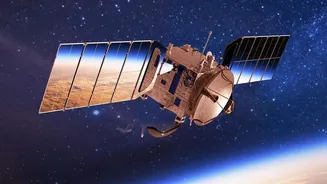
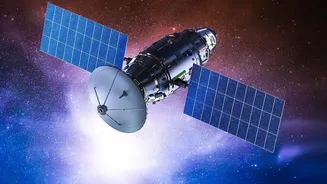
forecasting operate. This cosmic scrapyard, known as space debris, includes everything from old rocket stages to minuscule paint flecks. The European Space Agency estimates there are over a million objects larger than a centimetre. Travelling at such immense speeds, even a tiny piece of debris carries enough kinetic energy to catastrophically damage or destroy a multi-crore satellite, impacting services we rely on daily. Protecting India's valuable space infrastructure, which includes the NavIC navigation system and vital Earth observation satellites, has become a non-negotiable priority for the Indian Space Research Organisation (ISRO).
From Manual Alerts to AI Guardians
Until recently, protecting satellites was a ground-based effort. Teams at ISRO would receive collision alerts, often from international partners like the US, and manually plot a course correction. This involved firing the satellite's onboard thrusters to nudge it out of the predicted path of debris—a process known as a Collision Avoidance Manoeuvre (CAM). In 2025 alone, ISRO performed 20 such manoeuvres to safeguard its assets. While effective, this process can be slow and relies on human intervention. The 'breakthrough' lies in automating this entire process using Artificial Intelligence. The headline's "AI thrusters" refers not to a new type of engine, but to an intelligent, autonomous system that can predict a collision, decide on the best evasion path, and command the thrusters to fire, all without waiting for instructions from Earth. This dramatically speeds up response times and reduces the risk of human error in a high-stakes environment.
India's New Guard: Startups and ISRO
This technological leap is being driven by a combination of government initiatives and the country’s booming private space sector. ISRO has been enhancing its capabilities through Project NETRA, an early-warning system to track debris, and the IS4OM real-time monitoring centre. Simultaneously, Indian startups are developing the core AI technologies for what is known as Space Situational Awareness (SSA). Bengaluru-based Digantara, for instance, is a leader in SSA, developing AI-based software to detect patterns and assess risks in orbit. The company is building a space surveillance system called MOSAIC. Other startups like Pixxel and Cosmoserve are also collaborating on technologies for debris management, showcasing a vibrant ecosystem dedicated to orbital safety. This synergy is crucial for developing robust, self-reliant solutions.
Why This Matters for India's Future
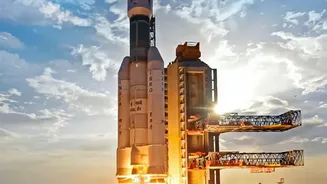
Developing autonomous protection systems is a game-changer for India's space ambitions. With major projects like the Gaganyaan human spaceflight mission on the horizon, ensuring a safe orbital environment is paramount. Autonomous AI-driven systems allow ISRO to manage its growing satellite constellations more efficiently, protecting critical infrastructure that underpins everything from national security to agricultural planning. Furthermore, this positions India as a global leader in a critical and emerging field: space traffic management. As more countries and companies launch satellites, the demand for reliable, automated safety systems will skyrocket. By developing this expertise domestically, India not only secures its own assets under the Aatmanirbhar Bharat vision but also creates a high-value technology that could be exported, turning a defensive necessity into a commercial opportunity.