





The Virtue of Patience
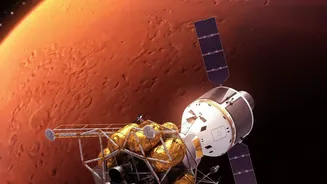
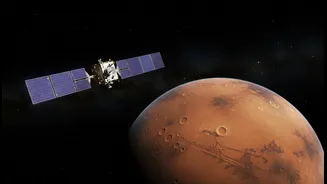
In space exploration, there are sprinters and there are marathon runners. Flyby missions are the sprinters; they get a quick, valuable snapshot of a celestial body as they pass. Mars Express, on the other hand, is a marathon runner. Launched in June 2003,
it was designed for a mission of just one Martian year (687 Earth days) but has far outlasted its warranty. This incredible longevity is its superpower. Instead of a single snapshot, Mars Express has been able to watch the planet breathe. It has observed seasonal changes, tracked weather patterns over multiple years, and repeatedly mapped the surface and subsurface under different conditions. This long-term presence transforms isolated data points into a coherent narrative, revealing the dynamic processes that shape Mars over time.
Following the Water
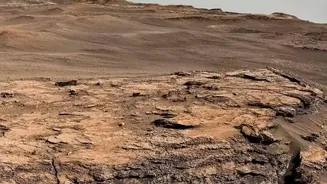
One of the mission's primary goals was to search for water, and its long-term vigil has paid off spectacularly. Early in its mission, it provided the first direct evidence of water ice at the planet's south pole, previously thought to be only frozen carbon dioxide. But it didn't stop there. Thanks to its ground-penetrating MARSIS radar, it has peered deep beneath the surface. It has found evidence of what may be a planet-wide groundwater system and even hints of stable bodies of liquid water buried under the south polar ice cap. More recently, it revisited a mysterious region near the equator called the Medusae Fossae Formation, finding evidence that suggests massive deposits of water ice may be buried there, potentially kilometres thick. These discoveries were not one-off events; they required years of orbital adjustments and repeated observations to build a convincing case.
A Weather Watcher for Another World
Understanding Mars means understanding its thin, volatile atmosphere. A single snapshot can't capture the planet's climate. Mars Express, however, has become Mars's long-serving weather satellite. It has monitored the ebb and flow of the polar ice caps as seasons change, tracked the formation of giant dust storms that can engulf the planet, and discovered localised aurorae. By repeatedly observing the atmosphere, scientists have been able to map how gases like water vapour and ozone are distributed and how the solar wind strips particles from the upper atmosphere, helping to explain how Mars lost its once-thicker air. The mission has even detected fleeting traces of methane, a gas that on Earth is linked to both geological and biological processes, though this remains an active area of scientific debate.
Unveiling the Mysterious Moons
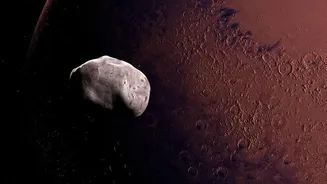
Mars's two small, lumpy moons, Phobos and Deimos, are enigmatic. Are they captured asteroids or something else entirely? Mars Express is uniquely positioned to study them up close. Over two decades, it has made numerous close flybys of Phobos, some as close as 45 kilometres, to create detailed 3D maps of its cratered surface. These repeated encounters allow scientists to refine our understanding of the moons' orbits, density, and composition, providing crucial clues about their mysterious origins. Its long-term presence has even allowed it to capture pioneering images of both moons in the same frame, a rare alignment that helps validate orbital models.
A Bedrock for Future Missions
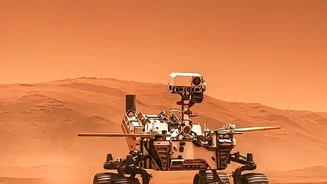
Perhaps the greatest legacy of Mars Express is the foundational knowledge it provides for all subsequent and future exploration. The detailed topographical and mineralogical maps created from its data are indispensable for selecting safe and scientifically interesting landing sites for rovers and, one day, human astronauts. Furthermore, the orbiter has served as a vital communications relay, helping landers like NASA's Perseverance rover send their precious data back to Earth. Having been extended until at least the end of 2026, its longevity allows it to support upcoming missions, including the Japanese-led Martian Moons eXploration (MMX) mission. It has transformed our view of Mars from a static, eternally frozen world to a dynamic planet with a complex past and a story that continues to unfold.