



A Frozen Library of Solar System History
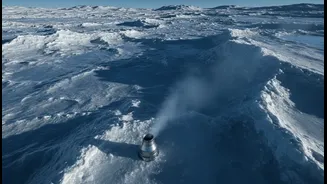
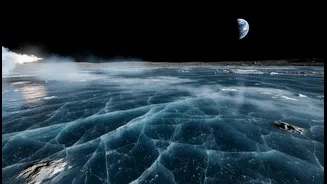
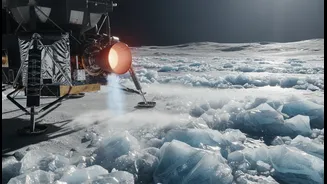
Deep within craters at the lunar poles lie regions that have not seen sunlight for billions of years. These permanently shadowed regions (PSRs) are among the coldest places in our solar system, acting as pristine time capsules. They contain water ice
that is believed to have been delivered by comets and asteroids long ago. Scientists are eager to study this ice because it holds a priceless record—clues about the formation of our solar system, the origin of water, and potentially even the building blocks of life on Earth. It’s a frozen library, preserved in the Moon’s deep freeze, that could answer some of humanity's most fundamental questions. The recent discovery that these ice deposits might be more widespread, though possibly less concentrated than once hoped, has only intensified scientific interest.
The Unintended Consequences of Landing
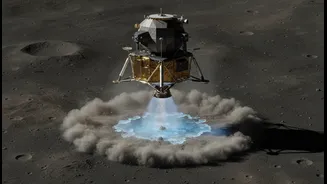
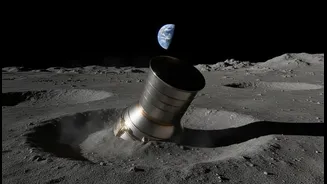
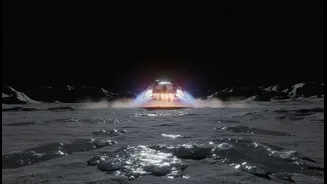
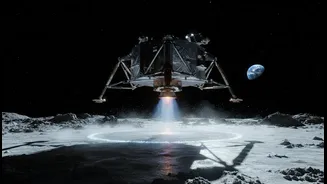
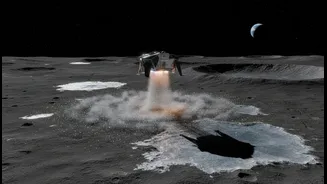
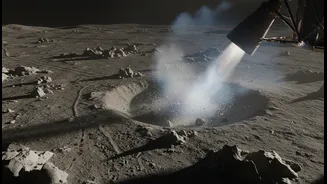
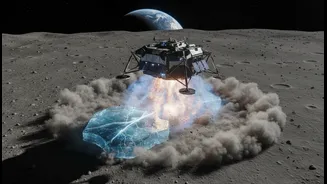
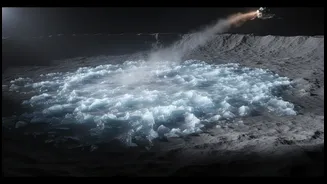
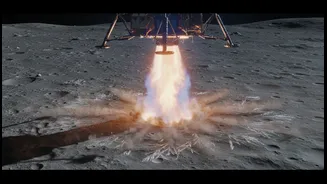
Paradoxically, the act of traveling to study this ancient ice is the biggest threat to its integrity. When a spacecraft lands on the Moon, its rocket engines blast the surface, kicking up abrasive soil and spewing exhaust. This exhaust is largely composed of water vapor and other chemicals like methane. In the Moon's near-vacuum, this cloud of gas expands rapidly. Studies show that exhaust from a single landing can spread across the entire lunar surface in a matter of hours or days. When these hot exhaust molecules hit the ultra-cold PSRs, they freeze instantly, creating a new, artificial layer of ice and contaminants. This modern pollution can blanket the ancient, natural ice, confounding scientific instruments and potentially erasing the very chemical signatures scientists hope to measure. A large lander could deposit tons of water, overwhelming the natural deposits.
Planetary Protection and Its Lunar Rules
To prevent this kind of cross-contamination, the international scientific community relies on a set of guidelines known as Planetary Protection. These principles, maintained by the Committee on Space Research (COSPAR), are designed to prevent us from contaminating other worlds with Earth life (forward contamination) and from bringing hazardous extraterrestrial material back home (backward contamination). For decades, the Moon was considered low-risk because it was thought to be biologically uninteresting. However, the discovery of polar ice prompted an update. Now, missions targeting the polar regions are subject to stricter documentation, requiring an inventory of organic materials and propulsion products released. Yet, these rules are simpler than for Mars; for most of the Moon, there are no restrictions on design or operations, only a requirement to report what you're releasing.
The Main Caveat: A Race Without a Referee
Herein lies the critical caveat. The entire framework of Planetary Protection is essentially a gentleman's agreement. The COSPAR policy is not legally binding international law. It provides guidelines for nations to follow to comply with the 1967 Outer Space Treaty, which broadly calls for avoiding "harmful contamination." However, there is no global authority to enforce these rules. This becomes hugely problematic in the new lunar gold rush, where multiple government agencies and, increasingly, private companies are planning missions. Frameworks like the Artemis Accords promote cooperation and deconfliction but are also non-binding and lack a clear mechanism for enforcement or territorial designation. A fundamental conflict is brewing between the scientific goal of preserving these pristine records and the commercial drive to extract water ice for rocket fuel and life support, a practice the Accords support. With no one to police the lunar frontier, we risk a tragedy of the commons, where the rush to exploit a resource destroys its scientific value for everyone.