



A Breakthrough in the Cosmic Search
The search for life beyond Earth has always been a search for water. In a significant leap forward, astronomers are using powerful new tools like the James Webb Space Telescope (JWST) to detect the chemical fingerprints of water vapour in the atmospheres
of exoplanets—planets orbiting stars other than our Sun. A recent discovery in mid-July 2026 highlighted this growing capability, with scientists identifying a new giant planet, Beta Pictoris d, by detecting the unique signature of its atmosphere. This spectroscopic approach, which analyses light to determine chemical composition, confirmed the presence of water vapour and methane, providing a rich look at the planet's atmosphere from the very first observation.
How to See Water from Light-Years Away
Detecting anything on a planet dozens of light-years away sounds like science fiction, but it hinges on a clever technique called spectroscopy. When an exoplanet passes in front of its host star from our perspective—an event called a transit—the star's light filters through the planet's atmosphere. Molecules in that atmosphere absorb specific colours, or wavelengths, of light. For astronomers, that filtered light acts like a code. By analysing the missing colours, they can identify the molecules responsible, such as water vapour, methane, or carbon dioxide. The James Webb Space Telescope, with its powerful infrared instruments, has been a game-changer. It can capture these incredibly subtle atmospheric signals from smaller planets with unprecedented clarity, something that was previously impossible.
More Than Just H2O
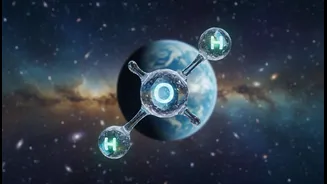
Finding water vapour is exciting, but its true significance lies in what it implies. The presence of water is a key 'biosignature'—a signpost that suggests a planet might have the right conditions for life as we know it. The discovery of water vapour in the atmosphere of a rocky exoplanet would be a major milestone toward characterising its habitability. For instance, the detection of water on the exoplanet WASP-107b, alongside sulfur dioxide but a surprising lack of methane, reshapes our understanding of planetary formation and evolution. Similarly, observations of the small planet GJ 9827d revealed water vapour, but scientists are still working to determine if it's a steamy, water-rich world or a 'mini-Neptune' with a hydrogen-heavy atmosphere. Each detection provides another piece of the puzzle.
A Galaxy of Water Worlds?
While finding water is a critical first step, not all water-bearing planets are habitable. Many of the planets where water has been detected are 'hot Jupiters' or 'sub-Neptunes'—gas giants orbiting extremely close to their stars, with scorching temperatures. For example, the planet TOI-421 b is a boiling-hot world where water vapour swirls in the air. Some exoplanets, like WASP-107b, are so hot they may even have clouds made of silicate sand. Other recent studies suggest that some sub-Neptune planets could have surfaces of molten magma. These findings, while ruling out life, are crucial for refining theories about where and how habitable planets form. The new techniques allow scientists to study a wide variety of worlds, helping them understand why some planets become barren rocks and others retain the ingredients for life.
The Next Frontier: Searching for Home
The ultimate goal is to find a truly Earth-like world: a rocky planet with a stable atmosphere orbiting in its star's 'habitable zone'—the region where temperatures allow liquid water to exist on the surface. The recent discovery of an atmosphere around a rocky, Earth-like planet called LHS 1140b is a promising step in this direction. The ability to detect water is just the beginning. The same methods can be used to search for other biosignatures like oxygen, which is produced by photosynthesis on Earth, and methane, which can be generated by living organisms. By comparing the chemical makeup of different planets in the same system, scientists hope to one day spot the tell-tale signs of a world teeming with life.