




The Age of Automation Anxiety
For years, the narrative around artificial intelligence has been laced with a sense of apprehension. We've seen AI generate stunning images, write coherent articles, and even produce code, leading to a widespread fear that creative and intellectual jobs
are on the chopping block. This anxiety isn't unfounded; AI excels at pattern recognition, optimization, and processing information at a scale and speed that humans simply cannot match. When a machine can produce a plausible logo or a draft of a report in seconds, it’s natural to question the future role of the human designer or writer. The fear is that AI commoditizes execution, turning what was once a skilled craft into a low-cost, automated process. This has led many to wonder what place is left for human professionals in a world where good-enough content can be generated almost instantly.
Beyond Mimicry: What AI Can't Do
The key to understanding the future value of human creativity lies in recognizing what AI, for all its power, struggles to replicate. AI models are masters of recombination; they learn from vast datasets of existing human work and can remix those patterns in novel ways. However, they lack lived experience, emotional intelligence, and true originality. An AI cannot feel the weight of a difficult leadership decision, understand the cultural nuance that makes a brand story resonate, or have a truly original idea that isn't derived from its training data. Skills like empathy, ethical judgment in ambiguous situations, strategic thinking, and genuine taste are not easily programmable. These abilities are shaped by a lifetime of unique experiences, social interactions, and even mistakes—the very things that form a human point of view. A study of creative professionals found that while AI can assist, it cannot replace the human touch needed to connect with an audience on an emotional level.
The Human as Creative Director
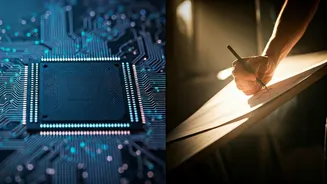
The rise of AI doesn't spell the end of the creative professional; instead, it reframes their role. The focus is shifting from pure execution to creative direction and strategic thinking. In this new paradigm, AI acts as a powerful collaborator or an “enthusiastic but inexperienced intern.” It can generate a dozen concepts, automate repetitive tasks, and analyze data, freeing up the human creator to focus on higher-level work. The most valuable professionals will be those who can expertly prompt, curate, and refine AI-generated output. This requires a strong sense of vision, taste, and the ability to ask the right questions—skills that are inherently human. Research has shown that individuals with greater divergent-thinking capabilities produce more creative AI-generated artwork, proving that human creativity remains a critical component in directing AI to produce valuable outcomes.
The New Premium on Originality
As AI floods the market with predictable, derivative content, a premium is placed on true originality. When 'good enough' becomes a commodity, 'truly remarkable' becomes exponentially more valuable. Businesses that want to stand out in a crowded market cannot rely on what has worked for others; they need a unique voice and vision to build a memorable brand. Originality is what drives innovation, challenges norms, and creates a lasting impact. A brand story that carries the texture of real human experience—with its flaws, learnings, and earned insights—will resonate far more deeply than a perfectly structured but soulless AI-generated narrative. In this environment, the ability to generate a genuinely new idea, to tell a story that feels authentic, and to build a brand with a unique identity becomes a key competitive advantage. Human creativity, in its scarcest forms, becomes a high-value asset.
Cultivating Your Creative Edge
To thrive in this new landscape, professionals must double down on their uniquely human skills. This means moving beyond technical execution and cultivating abilities that AI cannot easily replicate. Developing leadership and emotional intelligence is crucial for guiding teams and building trust. Honing your critical thinking and complex problem-solving skills will allow you to navigate ambiguous situations where there is no clear right answer. Building adaptability and a practice of continuous learning is essential in a rapidly changing environment. Furthermore, lean into the skills that require a human touch: deep empathy, persuasive communication, negotiation, and storytelling. The future does not belong to those who try to compete with machines on speed and volume. It belongs to those who cultivate the wisdom, judgment, and originality that AI can only ever imitate.