




Why the Step-Up Is a Fitness Essential
The step-up is a fundamental human movement you perform daily when climbing stairs or stepping onto a bus. As an exercise, it's a unilateral movement, meaning it works one leg at a time. This is crucial for identifying and correcting strength imbalances
between your left and right sides, which can improve overall muscle development and stability. Step-ups primarily target the largest muscles in your legs—the quadriceps and glutes—while also engaging your hamstrings and core for balance. Because you're lifting your own bodyweight against gravity, it's a functional exercise that builds strength that translates directly into everyday activities, from carrying groceries upstairs to hiking a steep trail. It's also gentler on the lower back compared to exercises like barbell squats, as the spine is under less direct load.
Finding Your 'Step' and Staying Safe
Before you begin, your first task is to find a suitable platform. Look for sturdy park benches, low retaining walls, or the bottom steps of a play structure. The ideal starting height is one where your knee forms roughly a 90-degree angle when you place your foot on it. Going too high too soon can compromise form and mobility. Safety is paramount. Always inspect the equipment before use. Check for stability by giving it a firm push; if it wobbles, find another spot. Avoid surfaces that are wet, as moisture can make them slippery. Also, be mindful that metal surfaces can become dangerously hot in direct sunlight. Finally, be considerate of the space's primary users—children. Try to schedule your workout for early mornings or evenings when the playground is less busy.
Mastering the Basic Step-Up Form
Proper form is what separates an effective exercise from a risky one. Stand facing your chosen step and place one entire foot firmly on the surface—not just the toes. Your heel should be fully supported. Lean your torso forward slightly, keeping your chest up, and brace your core. Drive through the heel of your top foot to lift your body straight up until you are standing tall on the platform. The most common mistake is pushing off forcefully with the back leg. This takes the work away from the leg you're trying to train. To avoid this, focus on having the leg on the step do all the lifting. Once standing, step back down slowly and with control. The lowering phase, or eccentric portion, is just as important for building strength.
Variations for Every Fitness Level
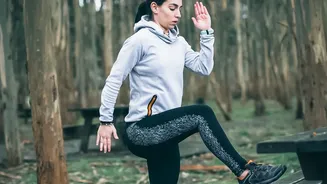
The beauty of the step-up lies in its scalability. If you're a beginner or returning to exercise, start with a very low step, just a few inches high. You can stand next to a railing or wall for balance support. As you get stronger, you can progress to a higher step. For an intermediate challenge, try the 'step-up to knee drive'. At the top of the movement, instead of placing your trailing foot down, drive that knee up toward your chest before lowering back down. This adds a balance and core stability challenge. For an advanced variation, focus on explosive power by stepping up as quickly and safely as you can. You can also add a lateral element by standing sideways to the step and performing lateral step-ups, which engage the inner and outer thigh muscles more.
Adding Step-Ups to Your Routine
Step-ups can be a standalone workout or part of a larger circuit. A simple and effective approach is to perform 2-3 sets of 8-12 repetitions on each leg. Focus on quality over quantity, ensuring your form is clean on every single rep. If you find one leg is significantly weaker, always start your sets with that leg to give it priority when you're fresh. You can combine step-ups with other playground-friendly exercises like push-ups on a bench, inverted rows on a low bar, and planks on the ground to create a full-body workout that costs nothing and gets you outdoors.