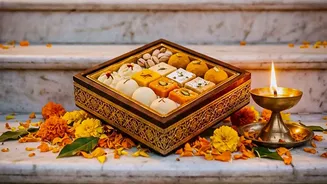

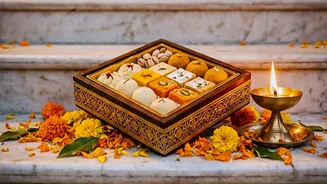
As Diwali approaches, boxes of mithai get a modern makeover with 'healthy' tags. From jaggery laddoos to baked karanji, these treats promise guilt-free indulgence. But how much healthier are they, and is any sweet truly a health food?
The New Look of Festive Mithai
The landscape of
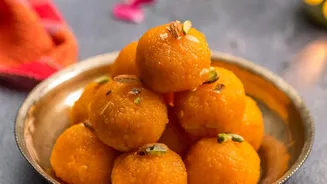
Diwali sweets is changing. In place of refined white sugar and maida, a new generation of mithai boasts ingredients like jaggery, dates, whole grains such as ragi and oats, and an abundance of nuts and seeds. These 'health-conscious' sweets cater to a growing awareness around wellness, promising the joy of tradition without the associated guilt. The methods are also evolving; deep-frying is often replaced with baking or air-frying. Popular options include dry fruit laddoos sweetened only with dates, baked gujiyas, and barfis made from millets and nuts. These sweets are presented as a way to enjoy the festival without compromising on health goals, offering better ingredients and preparation techniques.
The Jaggery vs. Sugar Debate
Jaggery (gur) is the star substitute in most healthy sweets. Unlike refined sugar, which is stripped of all nutrients, jaggery is unrefined and retains trace minerals like iron, potassium, and magnesium. This gives it a nutritional edge, however small. But here's the crucial point many people miss: jaggery is still a sugar. Its calorie count is nearly identical to that of white sugar, and some studies suggest it has a higher glycemic index, meaning it can spike blood sugar levels just as quickly, if not faster. While traditional Ayurvedic practices value jaggery for its warming properties and digestive benefits, from a modern nutritional standpoint, swapping sugar for jaggery does not significantly reduce your sugar intake. The real benefit comes from reducing the total amount of sweetener used, not just switching its type.
Are Baked Sweets a Free Pass?
Another major selling point for 'healthy' Diwali sweets is the cooking method. Baking or air-frying instead of deep-frying significantly reduces the amount of oil absorbed by the food. A baked gujiya is undoubtedly lower in fat and calories than its deep-fried cousin. However, this doesn't make it a low-calorie food. Ingredients like ghee, nuts, coconut, and flour still contribute to the overall calorie density. A dry fruit laddoo, for example, might seem healthy because it contains no refined sugar, but it is very calorie-dense due to the high concentration of nuts and dried fruits. The term 'baked' is a claim about the process, not a guarantee of the final product's nutritional profile. It’s a step in the right direction, but not a license to eat without limits.
The Calorie Reality Check
The 'health halo' is a real phenomenon where people tend to consume larger portions of foods they perceive as healthy. This is the biggest trap with health-conscious sweets. While a single baked, ragi_based laddoo may be a better choice than a traditional motichoor laddoo, its calorie count is still significant. For instance, a small besan laddoo has about 150_180 calories, while a piece of kaju katli has around 70_90 calories. A 'healthy' version might reduce this by 20_30%, but it doesn't bring the count to zero. A dry fruit barfi can easily pack over 150 calories per slice. The difference between gaining weight and maintaining it during the festive season often comes down to the second, third, and fourth piece, not the inherent 'healthiness' of the first.
The Art of Mindful Indulgence
Ultimately, the healthiest way to approach Diwali sweets isn't about finding a 'perfect' sugar_free , fat_free option. It's about shifting the focus from the ingredients to the experience. Mindful indulgence is the true key. This means choosing the sweets you genuinely love , whether they are traditional or 'healthy', and enjoying them in moderation. Savour each bite , eat slowly , and be present . Rather than eating sweets mindlessly between meals , have a small portion as a dessert after a balanced meal . Portion control remains the most effective tool . Deciding to have just one or two pieces and sticking to it is far more impactful than eating five 'healthy' sweets under the assumption that they don't count.