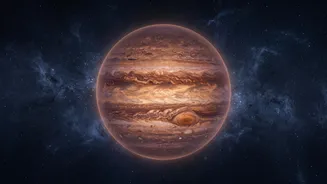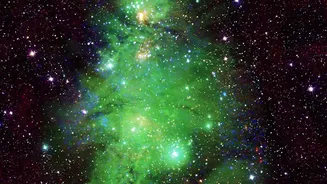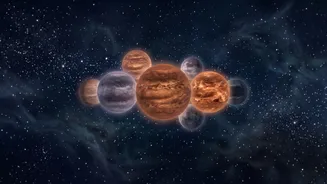






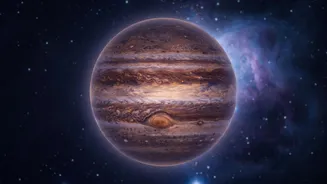
In the vast cosmic gallery, brown dwarfs are the odd ones out—not quite stars, but too massive to be planets. Now, early findings from NASA's SPHEREx telescope reveal these celestial misfits are far more diverse than ever imagined.
Not Quite a Star, Not Quite a Planet
Imagine trying to start
a fire with damp wood. You might get a flicker, a bit of smoke, and some heat, but never a roaring blaze. That, in a cosmic sense, is a brown dwarf. These objects are born from collapsing clouds of gas and dust, just like stars. However, they never accumulate enough mass to kickstart the nuclear fusion of hydrogen in their cores, the process that makes stars like our sun shine brightly for billions of years. They are more massive than planets like Jupiter but fall short of the stellar threshold. As a result, they smolder with leftover heat from their formation, slowly cooling and fading over time. Because of this 'in-between' status, scientists have long viewed them as a crucial link for understanding the full spectrum of celestial formation, from the smallest planets to the most massive stars.
A Cosmic Surveyor Called SPHEREx
Enter NASA’s Spectro-Photometer for the History of the Universe, Epoch of Reionization, and Ices Explorer, or SPHEREx. Launched in 2025, this new observatory is on a mission to do something unprecedented: scan the entire sky multiple times in near-infrared light, which is invisible to the human eye. Its goal is to create a grand cosmic map of the universe, but instead of just taking pictures, it measures the spectrum of the light it collects. This allows scientists to determine the chemical composition of what it sees. Think of it like a cosmic prism, breaking down the light from distant objects to read their chemical 'fingerprints'. While SPHEREx has broad goals, including studying the universe's rapid expansion after the Big Bang and mapping water and organic molecules across the galaxy, its ability to survey millions of objects makes it perfectly suited for studying relatively nearby phenomena, too.
A 'Chemical Fingerprint' Surprise
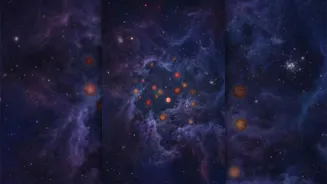
In one of its first major surveys, the SPHEREx science team turned its attention to a group of 37 known brown dwarfs. The results were unexpected. Instead of finding a relatively uniform group of smoldering embers, the telescope revealed a surprising level of chemical variety in their atmospheres. By analyzing the infrared light filtering through their upper layers, researchers found that some of the brown dwarfs were rich in water ice, while others showed strong signatures of methane or carbon monoxide. This diversity suggests that these objects didn't all form under the same conditions. A few even showed hints of silicates, the building blocks of rocky planets like Earth. It's as if each brown dwarf kept a unique recipe of the ingredients that were present in its corner of the galaxy when it formed millions or billions of years ago.
Connecting Dots to Planet Formation
This discovery is more than just a cosmic curiosity; it provides a vital window into the larger story of how planetary systems are born. The clouds of gas and dust that create brown dwarfs are the same kinds of nurseries that form stars and their orbiting planets. The chemical variety seen in these 37 brown dwarfs could mirror the diverse chemical environments of protoplanetary disks—the spinning platters of material around young stars from which planets coalesce. By studying the atmospheric composition of a brown dwarf, scientists can get a snapshot of the raw materials that were available for planet-building in that region. A brown dwarf rich in water ice, for example, tells us that its formation cloud was cold enough for water to freeze, a key condition for forming gas giants and delivering water to rocky worlds. In this way, brown dwarfs act as pristine fossils of the galaxy's planet-making potential.
What Comes Next for SPHEREx
This initial finding is just the beginning. As SPHEREx continues its all sky survey over the next couple of years, it is expected to identify thousands more brown dwarfs, creating a massive catalog for astronomers to study. The data from these 37 objects will help scientists refine their models of atmospheric physics and star formation. It also provides a list of compelling targets for more focused observations by other powerful observatories, such as the James Webb Space Telescope. By pointing Webb at the most intriguing brown dwarfs identified by SPHEREx, researchers can perform even more detailed analyses of their chemistry, searching for more complex organic molecules that are the precursors to life. The 'failed stars' of our galaxy, it turns out, may hold the key to understanding our own cosmic success.