
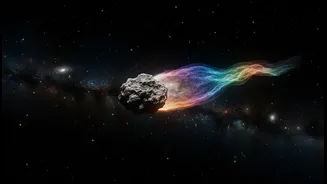


The Object That Woke Up
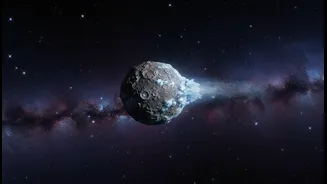
The object in question, known as (248370) 2005 QN173, was long considered just another resident of the main asteroid belt between Mars and Jupiter. It was discovered in 2005, catalogued, and assumed to be a relatively unremarkable, inactive piece of rock.
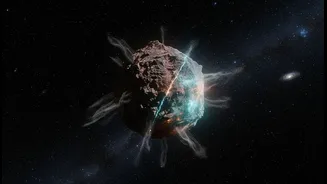
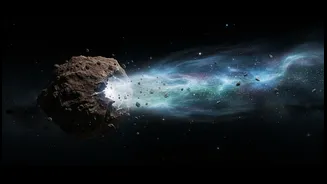
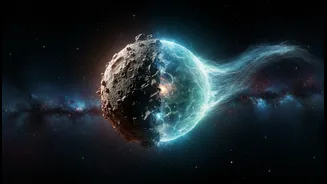
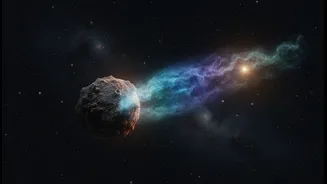
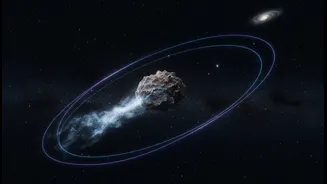
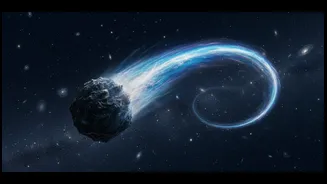
That all changed in July 2021, when astronomers noticed something astonishing: it had grown a long, narrow tail, stretching over 720,000 kilometres. Even more intriguing, archival images revealed it had done the same thing back in 2016. This wasn't a one-time event; it was recurrent activity. This behaviour—growing a tail as it gets closer to the sun—is the classic signature of a comet, caused by solar radiation sublimating ice into gas and dust. But 2005 QN173 was in the asteroid belt, a region where comets aren't supposed to live. This discovery made it one of a rare and baffling class of objects now known as 'main-belt comets' or 'active asteroids.'
The Enigma of 'Dark Comets'
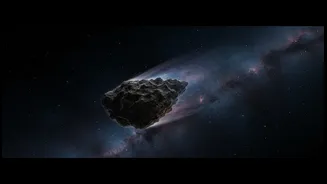
This leads to the fascinating and somewhat spooky concept of 'dark comets'. These are objects that have the icy composition of a comet but don't produce a visible coma or tail. They might be dormant, having formed a crust of dust that traps their volatiles, or they might be outgassing in ways that are difficult to detect from Earth. They look like asteroids, but their trajectory sometimes reveals a slight acceleration that can't be explained by gravity alone—a tell-tale sign of hidden outgassing. The interstellar visitor ‘Oumuamua in 2017 was a prime example, moving like a comet but without any of the visible signs. Some scientists now believe a significant fraction of near-Earth objects could be these stealthy dark comets, lurking in plain sight. Objects like 2005 QN173 might be a bridge, sometimes dark and dormant, sometimes awakening to reveal their true cometary nature.
Blurring the Cosmic Lines
The simple schoolbook definition—asteroids are rock, comets are ice—is officially obsolete. Science now views these bodies as existing on a spectrum. We have 'main-belt comets' like 2005 QN173, which have asteroidal orbits but cometary activity. We have objects like the asteroid Phaethon, which has no visible ice but produces the Geminids meteor shower every December, a typically cometary behaviour. And we have 'Manx' comets, named after the tailless cat, which follow a comet's path but are rocky like an asteroid. These hybrid objects are not just curiosities; they are crucial clues. They suggest the early solar system was a much more chaotic place, and that the distribution of ice and rock was not as cleanly separated as once believed. An icy body in the asteroid belt hints that the building blocks for life, like water, might have been available much closer to Earth than previously thought.
Why Better Questions Matter
This brings us to the heart of the matter: we need to ask better questions. Instead of forcing objects into rigid boxes labeled 'asteroid' or 'comet', scientists are now asking more nuanced questions. How active is it? What drives its activity? What is its composition and internal structure? These questions have profound practical implications. For planetary defense, knowing whether an incoming object is a solid rock or a fragile, icy conglomerate is critical for planning a deflection mission. The composition matters for a C-complex asteroid, which are often porous, as this could weaken the effectiveness of kinetic impact strategies. For science, understanding these bodies helps us piece together the origin of Earth's oceans and the formation of our solar system. The classification even has implications for future resource utilization, as the difference between a dry rock and an icy body is everything for potential space mining.