




1. Say Hello to the Decagon
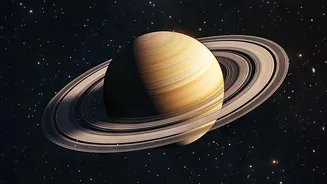
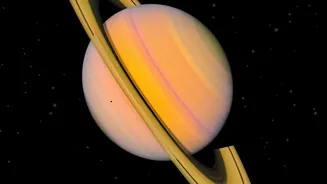
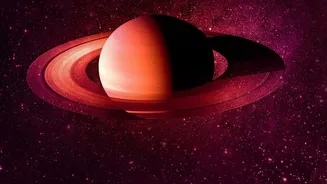
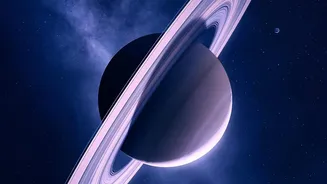
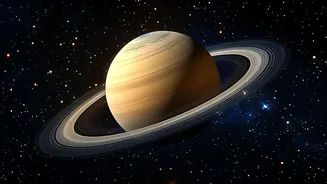
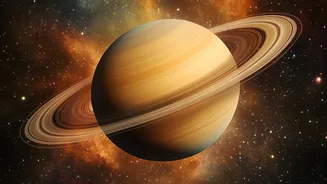
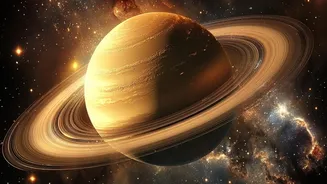
The big news is the discovery of a colossal, 10-sided atmospheric wave encircling Saturn's south pole. Dubbed a "decagon" by scientists, this is the first time a large, regular-sided weather pattern has ever been observed in the planet's southern hemisphere.
This isn't just a surface-level cloud pattern; observations show that the wave is a deep, vertically-extended structure that reaches through multiple layers of Saturn's atmosphere. The feature is part of one of the planet's powerful jet streams, a river of wind shaping the gas giant's clouds. Its sheer scale is immense, with a single side of the decagon estimated to be over 16,000 kilometres long. This finding, announced in early September 2026, fundamentally adds a new chapter to our understanding of Saturn's complex and dynamic climate.
2. It Has a Famous Northern Sibling
For decades, astronomers have been captivated by Saturn's north pole, which is home to a famous and persistent hexagonal storm. This six-sided jet stream has been observed for more than 40 years, dating back to the Voyager flybys in the 1980s. Scientists had long wondered if a similar feature existed at the south pole and actively searched for one, but missions like NASA's Cassini, which orbited Saturn for 13 years, found no evidence of a long-lived counterpart. The discovery of the southern decagon suggests the northern hexagon may not be as singularly unique as previously believed. However, the two are not identical. The hexagon is an established, stable feature, while the decagon appears to be younger and still evolving.
3. We Are Watching It Form in Real Time
Perhaps the most exciting aspect of this discovery is that astronomers are witnessing the birth of a giant planetary weather system. Unlike the ancient hexagon, the decagon appears to be a recent phenomenon. By digging into archival data from Hubble, researchers found faint hints of the structure beginning to emerge in observations from 2023. Images from 2024 and 2025 showed the pattern becoming progressively more distinct. This provides a rare and invaluable opportunity for scientists to study how these massive atmospheric patterns develop and strengthen over time. It’s a dynamic process happening hundreds of millions of miles away, and Hubble is giving us a front-row seat to watch it unfold. According to scientists involved, the feature appears to be strengthening, making it a live planetary science experiment.
4. A Long Game of Planetary Hide-and-Seek
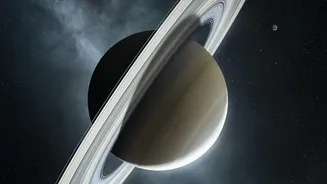
So why is this being discovered only now? The answer lies in Saturn's long seasons. The planet has an axial tilt of about 27 degrees, similar to Earth's, which causes seasons. However, a year on Saturn is about 30 Earth years long, making each season last for more than seven years. For a long period, from 2012 until recently, Saturn's south pole was tilted away from Earth, cloaked in its long winter darkness and hidden from our view. As Saturn has continued its slow journey around the Sun, the southern hemisphere has tilted back towards us, bringing the south pole into the light. This seasonal change finally gave astronomers the clear view they needed, leading to the decagon's detection. Early hints were even picked up by amateur astronomers before being confirmed by Hubble.
5. A Triumph for Hubble's Long-Term Vision
This discovery was made possible by the Hubble Space Telescope's Outer Planet Atmospheres Legacy (OPAL) program. OPAL is a long-term project dedicated to monitoring the outer planets annually. This consistent, year-after-year observation allows scientists to track changes that would be missed in a single snapshot. By comparing images over several years, the team could identify the decagon's subtle formation and confirm it was a real, evolving pattern, not a temporary fluke. It highlights the enduring power of Hubble, which has now been observing the cosmos for over three decades. Future observations, potentially using both Hubble and the James Webb Space Telescope, will be crucial to unraveling the mysteries of how and why this incredible 10-sided feature formed.