




A New Standard for Mission Longevity
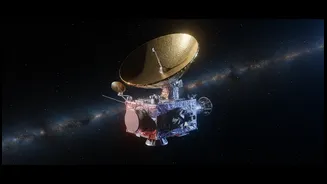
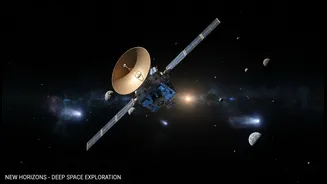
The secret to New Horizons' remarkable endurance lies in its power source: a Radioisotope Thermoelectric Generator (RTG). Unlike solar panels, which would be useless in the dim light of the outer solar system, the RTG generates electricity from the heat
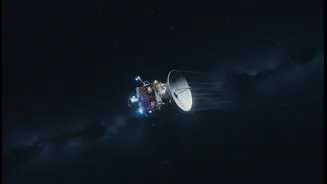
of decaying plutonium. This nuclear battery was designed for a long life, giving the spacecraft the power it needs to operate its systems and scientific instruments for decades. The mission team has also mastered the art of power conservation, routinely placing the spacecraft into long periods of hibernation to save energy during its cruise phases. After its longest hibernation yet—321 days—the probe awoke in June 2026 in perfect health, ready to resume its tasks nearly 6 billion miles from Earth. This combination of a robust power source and clever energy management provides a blueprint for future missions, proving that spacecraft can be built to last and continue delivering science well into the 2030s and even 2040s.
Mastering the Art of Deep-Space Operations
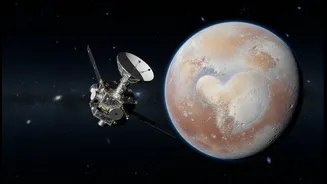
Communicating with a probe billions of miles away is a profound challenge. Radio signals traveling at the speed of light take nearly nine hours to make the one-way trip, meaning a simple command and confirmation can take the better part of a day. Mission operators at the Johns Hopkins Applied Physics Laboratory have become experts in this slow-motion conversation, meticulously planning command sequences weeks or months in advance. During its flybys of Pluto and Arrokoth, the spacecraft had to operate autonomously, executing a pre-loaded sequence of observations because real-time control was impossible. The team relies on NASA’s Deep Space Network, a global system of powerful antennas, to send commands and receive the faint signals carrying priceless data. The success of these operations, even with a mechanically simplified spacecraft designed to save weight and improve reliability, has set a new standard for managing complex missions at astronomical distances.
Rewriting the Science of the Kuiper Belt
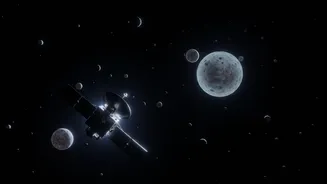
New Horizons is the first and only spacecraft to explore the Kuiper Belt, the so-called “third zone” of our solar system beyond the planets. Its 2019 flyby of Arrokoth, a snowman-shaped object a billion miles beyond Pluto, was a landmark achievement. Detailed analysis of Arrokoth revealed two lobes that gently merged, providing strong evidence for a leading theory of how planetesimals—the building blocks of planets—are formed. Scientists believe Arrokoth formed from the gentle collapse of a local cloud of particles, rather than through violent collisions. This finding helps us understand the earliest days of our solar system's formation. As it continues its journey, New Horizons acts as a unique observatory, studying the dust and plasma environment of the outer heliosphere and making distant observations of other Kuiper Belt Objects (KBOs) that are impossible to get from Earth.
The Quest for a New Destination
While its current mission focuses on studying the heliosphere, the team behind New Horizons is actively searching for another KBO for a potential flyby in the late 2020s or 2030s. Finding a suitable target is difficult; the object must be close enough to the spacecraft's trajectory to be reachable with its limited fuel. Astronomers are using powerful ground-based telescopes like the Subaru Telescope to scan the skies for potential candidates. Recent observations suggest the Kuiper Belt may be more extensive than previously thought, or that there might even be a second belt, which could increase the chances of finding a new target. Whether it finds another world to visit or not, New Horizons has sufficient power and fuel to continue operating into the 2040s, pushing toward interstellar space and joining the legendary Voyager probes as a messenger from humanity.