



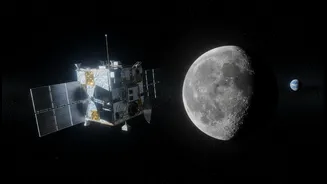


A Shoebox-Sized Pioneer
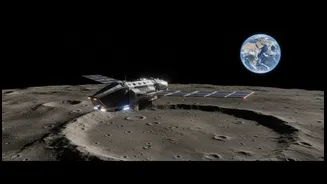
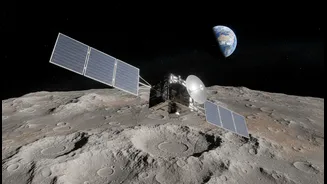
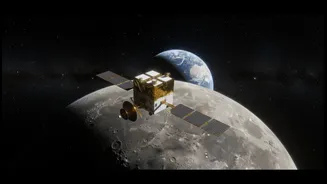
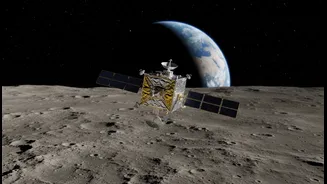
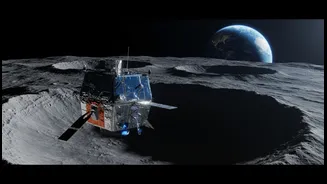
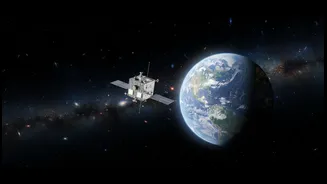
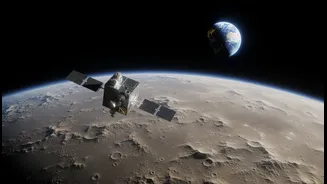
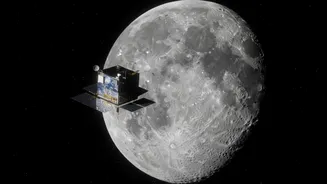
Launched in June 2022, the Cislunar Autonomous Positioning System Technology Operations and Navigation Experiment, or CAPSTONE, is a pathfinder mission. Owned and operated by commercial partner Advanced Space, this 25-kg CubeSat was designed to test a unique,
fuel-efficient orbit around the Moon called a near-rectilinear halo orbit (NRHO). This is the same orbit planned for the Gateway, NASA's future lunar space station that will support Artemis missions. After successfully entering and characterizing this orbit, CAPSTONE's mission was extended, transforming the tiny craft into a vital testbed for next-generation space technologies.
The Moon's Tricky Gravity
Navigating around the Moon isn't like driving with GPS. There's no existing satellite network to ping for your location. For decades, spacecraft have relied on the Deep Space Network (DSN) on Earth, a collection of massive antennas that track missions and send commands. But this system is already oversubscribed, creating a bottleneck as more missions head to the Moon. Furthermore, the Moon's gravity is notoriously uneven due to mass concentrations, or 'mascons', which can pull spacecraft off course. For sustained lunar operations, especially on the far side where direct communication with Earth is impossible, spacecraft need to be able to figure out where they are on their own.
A Spacecraft Finding Its Own Way
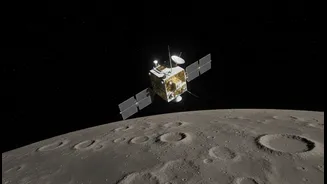
This is where CAPSTONE's main experiment comes in. The mission has been testing the Cislunar Autonomous Positioning System (CAPS), a software designed to let a spacecraft determine its own position. The system works by communicating with another spacecraft. CAPSTONE has been conducting peer-to-peer ranging tests with NASA's Lunar Reconnaissance Orbiter (LRO), which has been circling the Moon since 2009. By sending signals back and forth, the CAPS software onboard CAPSTONE calculates its position relative to LRO, effectively creating a two-satellite navigation system in lunar orbit. The goal is to prove that this method can work without relying on Earth-based tracking.
New Questions and Future Solutions
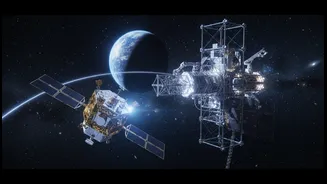
While NASA has declared the technology demonstrations successful, the process has highlighted new challenges and questions. Operating these systems has shown that factors like signal delays, the slow-moving and highly perturbed orbital environment, and the need for robust software that can handle unexpected issues are critical hurdles. The data gathered from the CAPSTONE-LRO interactions is helping engineers refine the navigation algorithms for future use. These findings are less about failure and more about discovery—pinpointing the precise difficulties that must be solved. The success of CAPSTONE has even led to NASA planning a follow-up, CAPSTONE 02, which will use two small spacecraft to further test autonomous rendezvous and proximity operations.
Paving the Way for Artemis
The work being done by this small CubeSat is fundamental to the future of space exploration. As NASA and its international partners plan for a sustained human presence on and around the Moon with the Artemis program, autonomous navigation is not a luxury—it's a necessity. It will allow for more efficient operations, reduce the strain on Earth's communication networks, and increase safety and capability for both robotic and crewed missions. CAPSTONE's journey, with all its challenges and learnings, is providing the essential data needed to build a reliable and independent navigation infrastructure for a bustling cislunar economy.