




A Day That Outlasts a Year
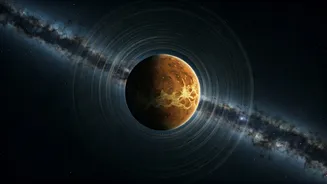
It sounds like a riddle, but it's a scientific fact. A single day on Venus, meaning one full rotation on its axis, takes about 243 Earth days to complete. [2, 5, 7] In contrast, Venus completes its entire orbit around the Sun—its year—in just about 225
Earth days. [2, 5] This means that on Venus, a day is bizarrely longer than a year. [7, 17] If you could stand on its surface, you would experience a sunrise, but you'd have to wait 117 Earth days for the sunset. [2] This temporal peculiarity makes Venus one of the most intriguing planets in our cosmic neighbourhood.
Why Time is So Warped
The reason for this time-bending phenomenon lies in Venus's incredibly slow and backward rotation. While most planets in our solar system spin counter-clockwise, Venus spins clockwise in what is known as a retrograde rotation. [5, 10] The Sun actually rises in the west and sets in the east. [7] The cause for this unique spin isn't fully confirmed, but leading theories suggest a massive collision with another large body during the solar system's chaotic formation period might have knocked it off course, or that the gravitational pull of its incredibly thick atmosphere has acted as a brake over billions of years, slowing its spin to a crawl. [5, 8, 11]
Earth's 'Evil Twin'
Despite being similar in size and mass to Earth, earning it the nickname "Earth's twin," Venus is far from a paradise. [15] Its differences are extreme and hostile, making it more of an "evil twin." [2] The planet is shrouded in thick, toxic clouds of sulfuric acid that completely cover it. [3, 9] This dense atmosphere, composed almost entirely of carbon dioxide, creates a runaway greenhouse effect. [1] This traps heat so effectively that surface temperatures soar to an average of 467 degrees Celsius, hot enough to melt lead. [2, 3] In fact, Venus is the hottest planet in the solar system, even hotter than Mercury, which is much closer to the Sun. [4, 17]
A World of Crushing Pressure
Imagine the pressure a kilometre deep in Earth's oceans—that's what it feels like to stand on the surface of Venus. [14] The atmospheric pressure is about 92 times greater than what we experience at sea level on Earth. [1, 2] This immense pressure would crush most objects, including the few robotic landers that have dared to visit. The Soviet Union's Venera probes in the 1970s and 80s were built like tanks, but even they couldn't survive for long. [2] The longest any probe functioned on the surface was just over two hours before succumbing to the heat and pressure. [2]
A Sky That Rains Acid
While the surface is a furnace, the upper atmosphere holds its own set of horrors. The planet's clouds are not made of water vapour, but of corrosive sulfuric acid droplets. [3, 9] However, due to the intense surface heat, this acid rain never actually reaches the ground. It evaporates in the lower atmosphere long before it has a chance to touch down, in a phenomenon known as virga. The upper atmosphere also experiences super-fast winds, whipping the clouds around the planet at speeds of over 300 kilometres per hour, much faster than the planet itself rotates. [9, 16]