
The Universe’s Smoky Rooms
Imagine trying to see across a smoke-filled room; the dense haze obscures everything. Much of the universe presents a similar challenge for astronomers. Many of the most fascinating cosmic events, like the birth of stars and the chaotic dance of matter
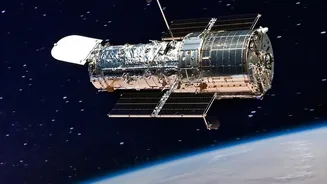
around supermassive black holes, happen inside vast clouds of cosmic dust and gas. This interstellar material, made of tiny particles much smaller than a grain of sand, is incredibly effective at blocking visible light—the kind our eyes and traditional telescopes like the Hubble Space Telescope primarily detect. As a result, huge and important regions of our own galaxy, and others far away, have remained obscured. Astronomers knew these “hidden regions” were where the action was, but they couldn't get a clear view inside. They were effectively locked out of the universe's most dynamic nurseries and chaotic city centers.
A New Set of Infrared Eyes
The game-changer has been the development of advanced space imaging, specifically the ability to see the cosmos in infrared light. Telescopes like the James Webb Space Telescope (JWST) are designed to capture this light, which is invisible to the human eye. Infrared light has a longer wavelength than visible light, which allows it to pass through cosmic dust clouds much more easily, just as radio waves pass through the walls of a building. By capturing this light, the JWST can effectively peer through the cosmic smoke and reveal what lies behind the veil. With its massive, 21-foot-wide mirror and highly sensitive instruments, the telescope can collect faint infrared light from the most distant and obscured objects, giving us an unprecedented view of the universe's hidden architecture.
Inside the Stellar Nurseries
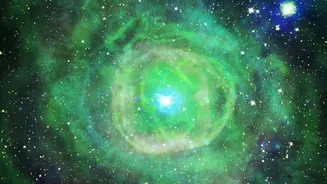
One of the most exciting applications of this technology is the exploration of stellar nurseries. These are massive, dense clouds where gas and dust collapse to form new stars and planets. From the outside, using visible light, they can look like dark, impenetrable smudges or beautifully glowing nebulae where the surface is lit up by nearby stars. But the processes happening deep inside were largely a mystery. Advanced infrared imaging cuts through the dust, revealing the 'blossoming' of new stars within. For the first time, scientists can see young stars still wrapped in their cocoons of gas and dust, watch jets of material being ejected by these infant suns, and study the protoplanetary disks where new worlds are forming. This provides crucial data on how quickly planets can form and how stars evolve in their earliest, most chaotic stages.
The Heart of the Galaxy
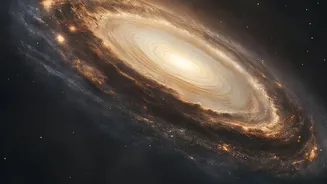
Another previously hidden region now coming into focus is the center of our own Milky Way galaxy and others like it. These galactic cores are incredibly dense and active places, home to supermassive black holes millions or even billions of times the mass of our sun. The thick dust and sheer number of stars have made it nearly impossible to get a clear view. Using infrared, astronomers are now piercing that shroud. Recent images of Sagittarius B2, the most active star-forming cloud in our galaxy located near the core, showcase the power of this technology. Scientists can now study how the immense gravity of the central black hole influences its surroundings, why some regions near the core form stars so prolifically while others do not, and how galaxies feed their central black holes.
Rewriting Cosmic History
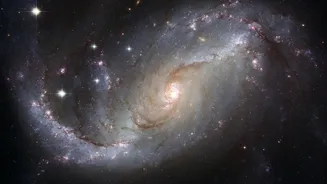
This new view isn't just providing pretty pictures; it's transforming our fundamental understanding of the cosmos and forcing scientists to rethink their models. By peering into hidden regions, we are not just seeing new things—we are seeing how galaxies are built. The data gathered helps astronomers understand the composition of cosmic dust itself, which is the raw material for future stars and planets. Furthermore, by looking at the most distant galaxies, JWST is looking back in time to the early universe. Discoveries of surprisingly bright and well-formed galaxies in the cosmic dawn challenge existing theories of how quickly these massive structures could form. This technology is not just helping us explore faraway galaxies, but it's also helping us piece together our own cosmic history, from the first stars to the formation of life-sustaining planets.